Honey extraction in the UK follows a reliable sequence: confirm ripeness, remove supers from the hive, uncap the comb, spin the honey out in an extractor, filter it through food-grade strainers, leave it to settle, then bottle it cleanly. Get every stage right and you’ll harvest honey that’s stable, legal to sell and genuinely delicious — while leaving your colony well-stocked for winter.
Some of the links in this article may be affiliate links. If you make a purchase through these links, we may earn a small commission at no extra cost to you. Thank you.
At a Glance: What UK Beekeepers Need to Know
- Ripeness is non-negotiable: The British Beekeepers Association recommends waiting until at least 80–90% of cells are wax-capped and confirming moisture content with a refractometer — aim for 18% water or below to prevent fermentation in the jar.
- Equipment doesn’t have to be expensive: You need an extractor, uncapping tools, food-grade buckets with honey gates, strainers and clean jars. Many local beekeeping associations loan extractors to members free of charge, keeping startup costs very manageable.
- UK law governs what you can sell: In England, honey sold to the public must meet the Honey (England) Regulations 2015, including a maximum water content of 20% and specific labelling requirements. Equivalent legislation applies in Scotland, Wales and Northern Ireland.
- Always leave enough for the bees: Most UK beekeepers aim to leave roughly 18–20 kg of stores in the hive going into winter, topping up with autumn feeding if needed.
When Is Your Honey Ready to Extract?
Timing is everything in honey extraction. Extract too early and you risk bottling fermented honey — a ruined batch before you’ve even put a lid on it. The good news is that bees give you clear signals when the honey is ready. They seal individual cells with wax once the moisture content is low enough to store safely, so capping is your first and most visible indicator.
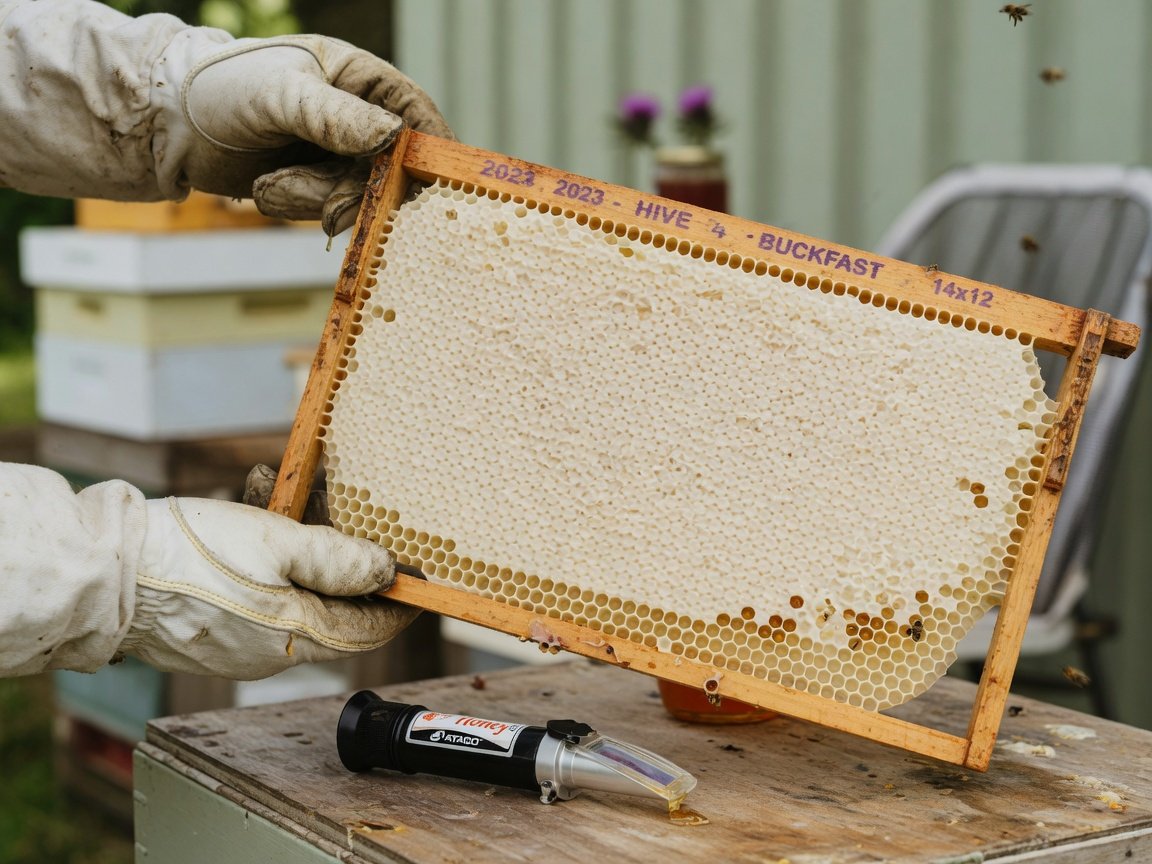
As a general rule, wait until at least 80–90% of cells on each frame are sealed with white wax cappings. For uncapped cells, do the shake test: hold the frame horizontally over the open hive and give it a firm shake. If nectar drips out, it isn’t ready. If nothing moves, that nectar is thick enough to be close to ripe.
Using a Honey Refractometer
A honey refractometer is one of the most useful tools any UK beekeeper can own. It measures the water content of honey using a tiny sample — just a drop placed on the prism. Most beekeepers target 18% water content or below, which significantly reduces the risk of fermentation. The UK Honey Regulations set a legal maximum of 20%, but best practice sits comfortably under that threshold, especially during a damp British summer. In very wet years, even capped honey can occasionally test above 18%, making the refractometer check genuinely important rather than just precautionary.
If only part of a super is capped, harvest the ready frames and return the rest to the hive a little longer. Timing also depends on your local forage season. In most parts of the UK, main-flow extraction runs from late June through late August, though heather honey in Scotland and northern England extends into September.
What Equipment Do You Need for Honey Extraction in the UK?
You don’t need to buy everything at once, and you certainly don’t need the most expensive versions to get started. Most new beekeepers are surprised to discover how much equipment they can borrow through their local association. With an estimated 50,000 beekeepers currently registered across the UK, associations are well-practised at supporting beginners with loaner kits and shared extraction facilities.
Here’s a practical checklist of what you’ll need:
- Bee escape or clearing board — placed under the super the day before extraction to clear bees without aggravation
- Uncapping tools — a heated or serrated uncapping knife, plus an uncapping fork for any patches the knife misses
- Uncapping tray or tank — catches wax cappings and the honey that drips from them
- Honey extractor — tangential or radial, manual or electric (more on this below)
- Food-grade ripener or bucket with honey gate — a minimum 15-litre capacity for a small extraction
- Filters or strainers — use at least two grades: coarse (around 400–600 micron) then fine
- Clean, dry jars and lids — standard 227 g or 340 g jars for retail; larger for personal use
- Honey refractometer — essential for accurate moisture testing before bottling
If you’re weighing up whether to invest in your own setup, the grants and funding options available to UK beekeepers are worth exploring — there are more pathways to financial support than most beginners realise.
How Do You Remove Supers and Clear the Bees?
Before a single frame comes off the hive, you need to clear the bees. Bringing supers into your extraction room full of bees is a recipe for chaos — angry insects, spilled honey and a very stressful afternoon. There are two main approaches used by UK beekeepers, and your choice will depend on how much time you have and how settled the colony is.
The most widely used method is a clearing board or bee escape. Fit it between the brood box and the super the evening before you plan to extract. Most bees will have moved down through the one-way gate by the following morning, leaving the super almost completely bee-free. This is calm, low-stress and well-suited to beginners.
The second approach — shaking and brushing — is faster but more disruptive. You shake each frame sharply over the open hive to dislodge the bees, then use a soft bee brush to clear stragglers. It’s useful when you need to harvest quickly, but it agitates the colony more. Whichever method you choose, keep supers covered with a cloth or board once removed. Exposed supers attract robbing bees and wasps almost instantly — a real problem in late summer when forage becomes scarce.
How Do You Uncap Honeycomb Properly?
Uncapping exposes the honey cells so the extractor can fling the honey out. The technique is straightforward once you’ve done it a few times. Rest the frame vertically on a support bar over your uncapping tray, then slice the wax cappings off in smooth, confident strokes using a warm serrated knife or uncapping plane. Work from the bottom of the frame upward, one clean stroke per side.
Don’t hack at it. Jerky movements tear the comb, waste wax and create unnecessary mess. Any low spots or indentations that your knife skips over can be cleared with an uncapping fork: drag the tines lightly across the surface to pierce the remaining cells without removing more wax than needed.
Set the cappings aside in a separate container rather than discarding them. They contain residual honey that can be strained out and consumed, and the beeswax itself is genuinely valuable — used for candles, cosmetics, furniture polish and waterproofing. Nothing from a hive extraction needs to go to waste.
How Does a Honey Extractor Work — and Which Type Do You Need?
A honey extractor spins frames at speed, using centrifugal force to throw honey out of the open cells and onto the extractor walls, where it runs down to the base and drains out through a honey gate into your settling bucket. It’s a beautifully simple piece of kit — and one of the more significant purchases in a beekeeper’s toolkit. The two main types are tangential and radial. They work differently and suit different scales of beekeeping.
| Feature | Tangential Extractor | Radial Extractor |
|---|---|---|
| Frame orientation | Frames face outward, tangent to the drum wall | Frames face inward like the spokes of a wheel |
| Spinning method | Spin one side, flip each frame, spin the other side | Both sides extracted simultaneously — no flipping needed |
| Typical capacity | 2–4 frames | 9–36 frames depending on model |
| Best suited to | Small-scale hobbyists with 1–5 hives | Larger apiaries and commercial producers |
| Comb preservation | Good if speed is managed carefully | Better — lower stress on new or delicate comb |
| Typical UK cost (new) | From approximately £150 | From approximately £350–£500+ |
Always start the extractor slowly and build up speed gradually. Cranking it up too fast — especially with new comb — risks collapsing the cells and making a mess of your frames. Most beekeepers learn this once and adopt a patient approach from then on. Keep the extraction room warm if you can: honey flows far more easily above about 20°C, and warm honey drains from the extractor much faster than cold, thick honey.
Case Study: First-Season Extraction, Shropshire, August 2026
A first-year beekeeper with two National hives borrowed a 4-frame tangential extractor from their local association for an August harvest. Before extracting, they checked each super with a refractometer, recording moisture readings of 17.2% and 17.8% across the two supers — both safely below the 18% target. Total yield: 28 lbs of honey across both hives. Three kilograms were retained in each hive as early winter store provision, with the remainder bottled into 227 g jars and sold at a village market. No fermentation, no rejects. The refractometer — cost: £18 — paid for itself on that single extraction day.
How Do You Filter and Settle Honey After Extraction?
Once honey leaves the extractor, it contains wax particles, air bubbles and fine debris from the comb. Filtering removes the solids; settling lets the bubbles rise. Both steps matter before you put a lid on anything.
Run the honey through two filters in sequence: a coarse strainer first to catch larger wax crumbs, then a finer mesh of around 400–600 microns for the remaining particles. Let gravity do the work. Don’t squeeze or force honey through the filters — this pushes fine particles through the mesh and introduces additional air bubbles that then need longer to settle out.
Once filtered, transfer the honey into a clean food-grade ripener or bucket with a well-fitting lid. Leave it to settle undisturbed for at least 24–48 hours, though 72 hours gives a noticeably cleaner result. During this time, any remaining air bubbles and fine particles float to the surface and form a pale foam that can be skimmed off easily before bottling.
Keep settling honey in a warm room — ideally 18–25°C — if possible. Cold honey thickens and settles far more slowly. Avoid temperatures above 40°C during any part of the process: overheating degrades quality, drives off the volatile aromatic compounds that give your honey its character, and can destroy beneficial enzymes.
How Do You Bottle Honey Correctly in the UK?
Bottling is the most satisfying stage of the whole process — and the point where hygiene matters most. Contamination here can compromise shelf life and, if you’re selling, your legal compliance with food safety standards.
Use only clean, food-grade glass or plastic jars with tight-fitting lids. Wash them in hot soapy water, rinse thoroughly and allow to air-dry completely — or sterilise in a low oven at 100°C for ten minutes. Even a trace of moisture inside a jar introduces fermentation risk once the honey is sealed inside.
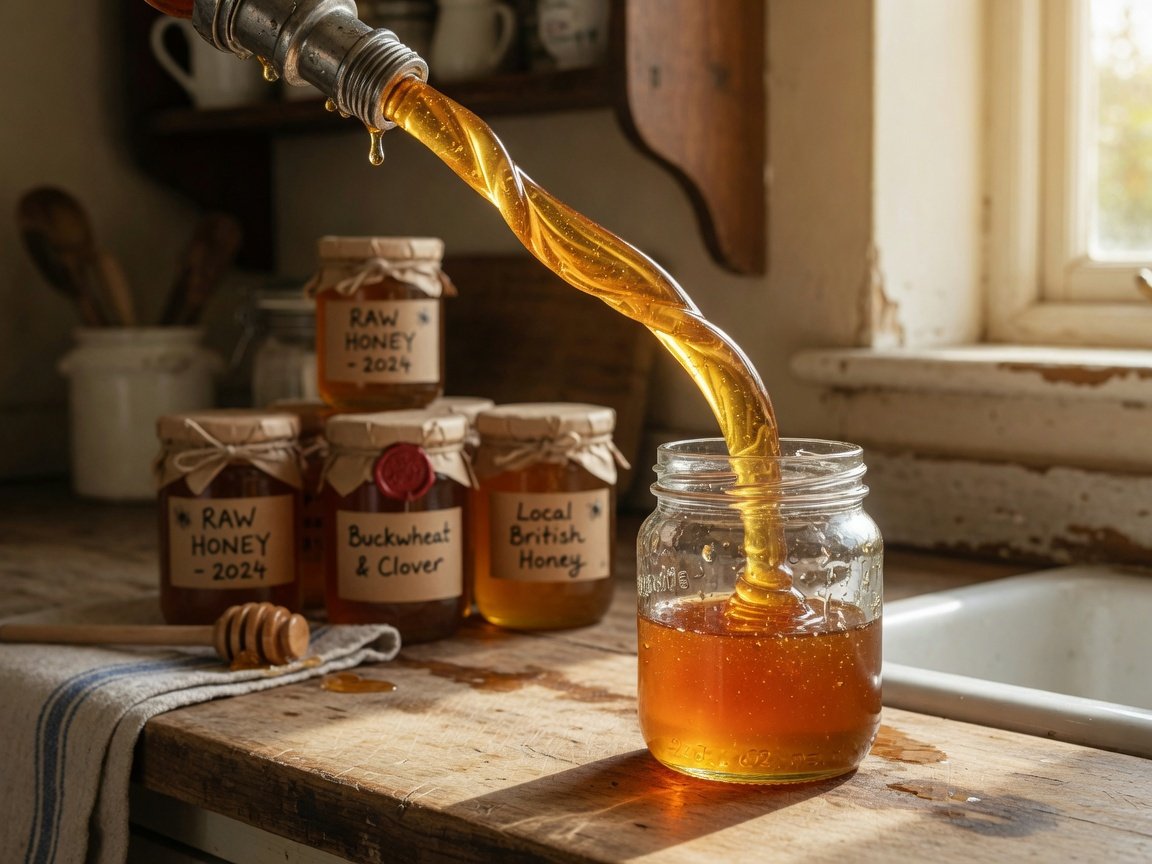
Open the honey gate slowly and fill each jar, leaving around 10–12 mm of headspace at the top. Fit lids firmly while the honey is still warm — the slight contraction on cooling creates a gentle vacuum seal. Wipe jars clean of drips immediately. Sticky jars attract moisture and look unprofessional if you’re selling.
Store filled jars in a cool, dry place away from direct sunlight. Most UK honeys crystallise naturally within 3–12 months of extraction — this is completely normal and a sign of unprocessed, high-quality honey. If you prefer a runny product, gentle warming in a bain-marie kept below 40°C will reliquify it without significant quality loss. For a smooth, spreadable soft-set texture, controlled seeding and crystallisation can be done deliberately.
What Are the Hygiene and Legal Requirements for UK Honey?
Whether you’re selling a few jars at a village fete or supplying a local deli, UK honey sold to the public is a regulated food product. The Honey (England) Regulations 2015 — and equivalent legislation across Scotland, Wales and Northern Ireland — set out what honey can and cannot contain, how it must be labelled, and the quality standards it must meet. These rules apply even at the smallest commercial scale.
Key legal requirements include:
- A maximum water content of 20% for most honeys (18% for heather honey) — your refractometer reading is your evidence
- No additives of any kind — honey must be pure, with nothing added or removed beyond filtering and extraction
- Clear labelling covering the country of origin, net weight, the food name (“honey”), a best-before date, and the producer’s name and address
- Registration as a food business with your local authority if you sell regularly, even at small scale
- Compliance with general food hygiene regulations covering equipment, premises and personal hygiene
On the disease side, never extract honey from any colony suspected of carrying a notifiable disease such as American Foulbrood. Extraction equipment can spread disease spores between apiaries extremely efficiently, with serious consequences. If you have any concerns about colony health, contact your regional bee inspector before extracting anything.
How Much Honey Should You Leave for Your Bees?
One of the most common — and most serious — errors new beekeepers make is taking too much. A colony going into winter without sufficient stores can starve quickly and silently during a cold February or March, when there’s nothing flying and no forage available. By the time you notice something is wrong, it’s often too late.
The standard guideline for UK winters is to leave the equivalent of a full brood box of stores — roughly 18–20 kg of honey. That figure varies depending on hive type (a Langstroth brood box holds more than a National), colony strength, local winter length and the availability of late-season forage such as ivy, which provides a useful natural top-up in many parts of England and Wales.
Weigh your hive or do a careful frame-by-frame inspection before removing supers. If stores look borderline after extraction, begin autumn feeding with a heavy sugar syrup — 2:1 sugar to water by weight — in September while temperatures are still warm enough for bees to process and cap it properly. Many UK beekeepers also keep a block of fondant on hand as an emergency winter supplement, placed directly above the cluster if stores run low mid-winter.
What Are the Most Common Honey Extraction Problems — and How Do You Fix Them?
Even experienced beekeepers hit snags during extraction. Here are the four most common problems and how to deal with them before they cost you a batch.
Honey Fermenting in the Jar
This is almost always a moisture problem. Honey above 20% water content, sealed in a jar, will be fermented by naturally occurring wild yeasts — often within weeks. The fix: always refractometer-check before bottling, and never bottle honey from frames that were largely uncapped. In a wet UK summer — and there are plenty of those — moisture checking becomes a non-negotiable step rather than an optional one.
Comb Collapsing in the Extractor
New, freshly drawn comb is more fragile than older dark comb. Spin it too fast and the cells collapse into a waxy tangle that takes time to untangle and can block your filters. Always start at low speed and increase gradually. New comb also benefits from being slightly cooler during extraction — a firmer wax structure resists centrifugal force better than warm, pliable new foundation.
Wax Particles in Finished Jars
If wax specks are making it past your filters and into bottled honey, check that your strainers are correctly seated and not overflowing. A coarse pre-filter followed by a 400-micron fine mesh should catch virtually everything. Also consider extending your settling time — many fine particles that survive filtration will still float to the surface and join the skim layer given enough time in the ripener.
Unexpected Rapid Crystallisation
Some UK honeys — particularly those from oilseed rape, which has a very high glucose-to-fructose ratio — can begin to set within days of extraction. If you want a clear runny product, extract and bottle quickly before the glucose crystallises. If crystallisation has already started in your ripener, gentle warming to around 35°C will reliquify it. For a deliberate smooth soft-set, seed with a small amount of previously set honey and control the temperature carefully during the setting process.
What Does the Future Look Like for UK Honey Extraction?
The next 12–24 months are likely to bring incremental but meaningful changes to how UK beekeepers approach extraction and quality assurance. Three trends are worth watching closely.
First, digital moisture monitoring is becoming more accessible to hobbyist beekeepers. Bluetooth-connected refractometers that log readings to a smartphone app are now available at consumer-friendly price points. These allow beekeepers to track moisture trends across a season and build a quality history useful for traceability — increasingly relevant as buyers and food safety auditors seek documentation.
Second, shared honey rooms and extraction cooperatives are growing across the UK, driven by rising equipment costs and the growing appetite for high-quality local honey. Rather than every beekeeper owning their own extractor, community hubs allow efficient use of commercial-grade stainless equipment that exceeds what any individual hobbyist would purchase.
Third, provenance and traceability are becoming genuine market differentiators. As consumers pay more attention to food origins, UK honey producers who document forage sources, extraction dates and moisture readings are better positioned to command premium prices — both direct-to-consumer and through specialist retailers. Research from UK food sector analysts in 2026 suggests that provenance labelling correlates with a 20–35% price premium for artisan honey products compared with unbranded equivalents.
Honey Extraction UK: Frequently Asked Questions
How do I know when my honey is ready to extract in the UK?
Look for frames where at least 80–90% of cells are sealed with wax cappings. Do the shake test: hold the frame horizontally and give it a firm shake over the open hive. If nectar drips out, it’s not ready. If nothing moves, use a refractometer to confirm the moisture content is 18% or below before you extract.
Can I extract honey without a spinner or extractor?
Yes — the crush-and-strain method involves cutting the comb into a straining bag or sieve and letting honey drain through by gravity. It’s simple and requires no specialist equipment. The drawback is that it destroys the comb, meaning your bees have to draw fresh foundation again from scratch, which takes time, energy and wax. For most UK beekeepers with more than one hive, a borrowed or shared extractor is a better option.
How long should honey settle before bottling?
A minimum of 24–48 hours in a covered food-grade ripener or bucket, but 72 hours gives noticeably cleaner honey. During this time, air bubbles and fine wax particles rise to the surface and can be skimmed off. Keep the honey in a warm room around 20–25°C to encourage efficient settling without overheating.
Do I need to register to sell honey in the UK?
You don’t need a specific honey seller’s licence, but you must register as a food business with your local authority if you sell honey regularly — even at small scale. Your honey must comply with the Honey (England) Regulations 2015 (or equivalent in Scotland, Wales and Northern Ireland), including correct labelling. Contact your local Trading Standards office for guidance on what applies to your specific operation.
Why is my extracted honey crystallising so quickly?
Rapid crystallisation is characteristic of honey with a high glucose-to-fructose ratio — particularly common in UK honeys derived from oilseed rape. It’s completely natural and doesn’t indicate a quality problem. To slow it down, extract and bottle promptly, store jars at room temperature rather than in the fridge (cold accelerates crystallisation), and keep lids tightly sealed to prevent moisture absorption.
How much honey should I leave for my bees over winter?
Most UK beekeepers aim to leave 18–20 kg of stores in the hive going into winter — roughly a full National brood box of capped honey. If stores are low after extraction, begin feeding with 2:1 sugar syrup in September while temperatures still allow bees to process and cap it. Fondant is a useful emergency top-up if stores run low after the colony clusters for winter.
Can I extract honey from a colony showing signs of disease?
No — never extract honey from any colony suspected of having a notifiable disease such as American Foulbrood or European Foulbrood. Extraction equipment can spread disease spores between colonies and apiaries very efficiently. If you have any concerns about a colony’s health, contact your regional bee inspector before proceeding with extraction.
Ready to Harvest? Your Extraction Timeline for a Successful 2026 Season
Honey extraction isn’t complicated — but it does reward preparation and patience. Get the sequence right, confirm moisture before you bottle anything, and you’ll produce a product that’s stable, legal and genuinely representative of what your bees have been working on all season. Here’s a simple timeline to follow:
- 6–8 weeks before extraction: Assess supers regularly. Note which frames are capping up and consider whether to split partially-capped supers to harvest selectively.
- 2–3 days before: Source any borrowed equipment from your association. Clean all extraction gear thoroughly. Check that jars, lids and labels are ready.
- The evening before: Fit clearing boards under the supers you plan to harvest.
- Extraction morning: Confirm ripeness with a refractometer before starting. Set up your extraction room with covered areas for supers, a warm uncapping knife and your filtration setup.
- During extraction: Work methodically — uncap, spin, drain through filters into your settling bucket. Keep everything covered when not in active use.
- 24–72 hours later: Skim surface foam, run a final moisture check, then bottle into clean dry jars. Label immediately with all required information.
- After extraction: Check hive stores carefully and begin autumn feeding if levels are borderline. Clean all extraction equipment thoroughly before storing for the season.
Follow this sequence and the main variables in your harvest become the bees and the weather — which is exactly where your attention should be. For anyone who wants to go deeper on the biology and craft behind the process, a thorough guide to beekeeping and honey processing covers everything from hive management right through to finished product.