Yes, you can get grants for raising honey bees — and in 2026, there’s more funding available than ever before. From federal USDA programs to state agriculture departments and private foundations, beekeepers at every level can tap into real money to start or expand their hives.
Some of the links in this article may be affiliate links. If you make a purchase through these links, we may earn a small commission at no extra cost to you. Thank you.
Whether you’re just getting started or you’re managing a growing operation, this guide walks you through every major funding source, what you can spend the money on, and exactly how to apply. Let’s get into it.
Key Takeaways
- The USDA EQIP program is the largest federal source of beekeeping grants, covering equipment, training, and hive management practices
- Individual grant awards range from a few hundred dollars through local programs up to $10,000 or more through federal and state initiatives
- Beginners and experienced beekeepers both qualify — different programs target different stages of the journey
- Strong applications centre on pollinator habitat, community education, and sustainable practices
- Most grants have annual application cycles, so knowing the deadlines is half the battle
What Are Grants for Raising Honey Bees and Who Qualifies?
Beekeeping grants are funds awarded — not loaned — to individuals, farms, schools, and nonprofit organisations to support honey bee management and pollinator health. The key word there is “awarded.” You don’t pay them back.
Eligibility varies by program, but most fall into a few broad categories. Small-scale hobby beekeepers with one to ten hives can qualify for entry-level and community programs. Small-farm operators and commercial beekeepers often qualify for USDA and state agriculture programs. Schools, 4-H groups, and nonprofits can access separate educational and conservation funding streams. Even urban beekeepers with rooftop hives have dedicated programs available in some states.
The common thread across almost every grant program is pollinator health. Honey bees pollinate roughly one-third of the food supply, according to U.S. Department of Agriculture estimates. That economic reality is exactly why governments and foundations are willing to fund individual beekeepers — your hive is doing a job that benefits everyone.
Why Is the Government Paying People to Keep Bees?
Honey bee populations have faced serious pressure over the past two decades. Colony collapse disorder, varroa mite infestations, pesticide exposure, and habitat loss have all contributed to declining bee numbers across North America. Research from the Bee Informed Partnership has shown that annual colony losses in the United States have consistently hovered between 30% and 45% in recent survey years — numbers that alarm agricultural economists and food security experts alike.
The financial stakes are enormous. Pollination services contribute an estimated $15 billion to U.S. crop values annually, according to USDA data. When bee populations decline, yields fall and food prices rise. That’s why federal and state governments treat beekeeping support as an investment in the broader food system, not just a perk for hobbyists.
In 2026, pollinator health remains a top priority in U.S. farm policy. The most recent Farm Bill allocations have continued dedicated funding for pollinator conservation, channelled through programs like EQIP, SARE, and the Honey Bee Health Coalition’s initiatives. The bottom line: keeping bees is now recognised as environmental infrastructure. And when something is infrastructure, governments fund it. That’s good news for you.
What USDA Programs Offer Grants for Beekeeping?
The USDA is by far the largest single source of beekeeping grant funding in the United States. Several programs fall under its umbrella, and it’s worth understanding each one separately.
Environmental Quality Incentives Program (EQIP)
EQIP, administered by the USDA Natural Resources Conservation Service (NRCS), is the go-to program for most beekeepers. It provides financial and technical assistance to agricultural producers who adopt conservation practices. For beekeepers, covered practices include establishing forage habitat for pollinators, installing water sources for bees, purchasing hive equipment, and applying integrated pest management techniques.
EQIP payments are based on practice rates set by each state’s NRCS office, so the amount you can receive varies by location. Payments can reach several thousand dollars per year for producers who implement multiple qualifying practices. Applications are ranked and funded through a competitive process, with new signup periods typically opening each autumn. The NRCS office in your county is your first stop — they can walk you through the application and tell you exactly which practices are funded in your state.
Sustainable Agriculture Research and Education (SARE) Grants
SARE, another USDA-funded program, focuses on research and education rather than direct equipment purchases. Farmer and Rancher grants through SARE support on-farm research projects, and beekeeping projects related to sustainable honey production, natural pest management, or pollinator habitat improvement are strong candidates. These grants can run from $7,500 to $30,000 depending on project scope and region. SARE operates four regional programs, so you’ll apply through the office covering your area.
Beginning Farmer and Rancher Development Program (BFRDP)
If you’re new to beekeeping and farming, BFRDP-funded organisations in your state may offer training, mentorship, and equipment assistance specifically for beginning agricultural producers. These aren’t direct grants from USDA to individuals — instead, USDA funds training organisations, which then deliver services and sometimes equipment to beginning farmers including beekeepers. Check with your local cooperative extension service to find BFRDP-funded programs operating near you.
Are There State-Level Beekeeping Grants Available?
Yes — and in many cases, state programs are easier to access than federal ones. Most states with active agricultural sectors have some form of apiary assistance, either through their department of agriculture or through state-funded conservation programs.
States like California, New York, Texas, Florida, and Pennsylvania have dedicated pollinator health programs that include direct funding for beekeepers. California’s Department of Food and Agriculture has historically funded apiary registration, disease testing, and habitat improvement work. New York’s Soil and Water Conservation Districts often run mini-grants for agricultural producers that beekeepers can access. Texas A&M AgriLife Extension offers beekeeping education programs with cost-share components.
The best way to find what’s available in your state is to contact your state’s department of agriculture directly and ask specifically about apiary, pollinator, or small farm programs. Your county cooperative extension office is another excellent starting point — extension agents know local funding opportunities that never make it onto national databases.
Some states also run their own specialty crop block grant programs using federal pass-through funding. Honey qualifies as a specialty crop, which means honey producers can access funding that wouldn’t otherwise be available to general farmers. Awards under these programs typically range from $1,000 to $50,000 depending on project scope.
What Nonprofit and Private Organisations Fund Beekeeping?
Beyond government programs, a growing number of private foundations and nonprofit organisations fund beekeeping projects. These sources are especially valuable for urban beekeepers, educational programs, and projects that don’t fit neatly into agricultural grant categories.
The Pollinator Partnership, a nonprofit focused on pollinator health, offers funding and resources for projects that establish or restore pollinator habitat — which often includes supporting beekeeping operations as part of broader ecological goals. The North American Pollinator Protection Campaign coordinates with multiple funders and can connect applicants to appropriate programs.
The National Honey Board and the American Beekeeping Federation both periodically fund research and education initiatives. While these aren’t typically direct grants to individual beekeepers, they support projects that benefit the broader community and may include equipment, training, or mentorship components accessible to individual members.
Community foundations at the local level are an underused resource. Many offer small grants for agricultural education, food security, or environmental stewardship that beekeeping projects fit within naturally. A $500 to $2,500 community foundation grant might not sound transformational, but it can cover the cost of your first two or three hives. Check with your local community foundation or United Way affiliate to see what’s available in your area.
Corporate foundations in the agriculture and food sectors also fund pollinator health. Companies with large agricultural supply chains have an obvious interest in healthy bee populations and sometimes offer grants to farming communities, beekeeping clubs, or educational programs. These opportunities are less predictable but worth watching for.
How Much Money Can You Actually Get From a Beekeeping Grant?
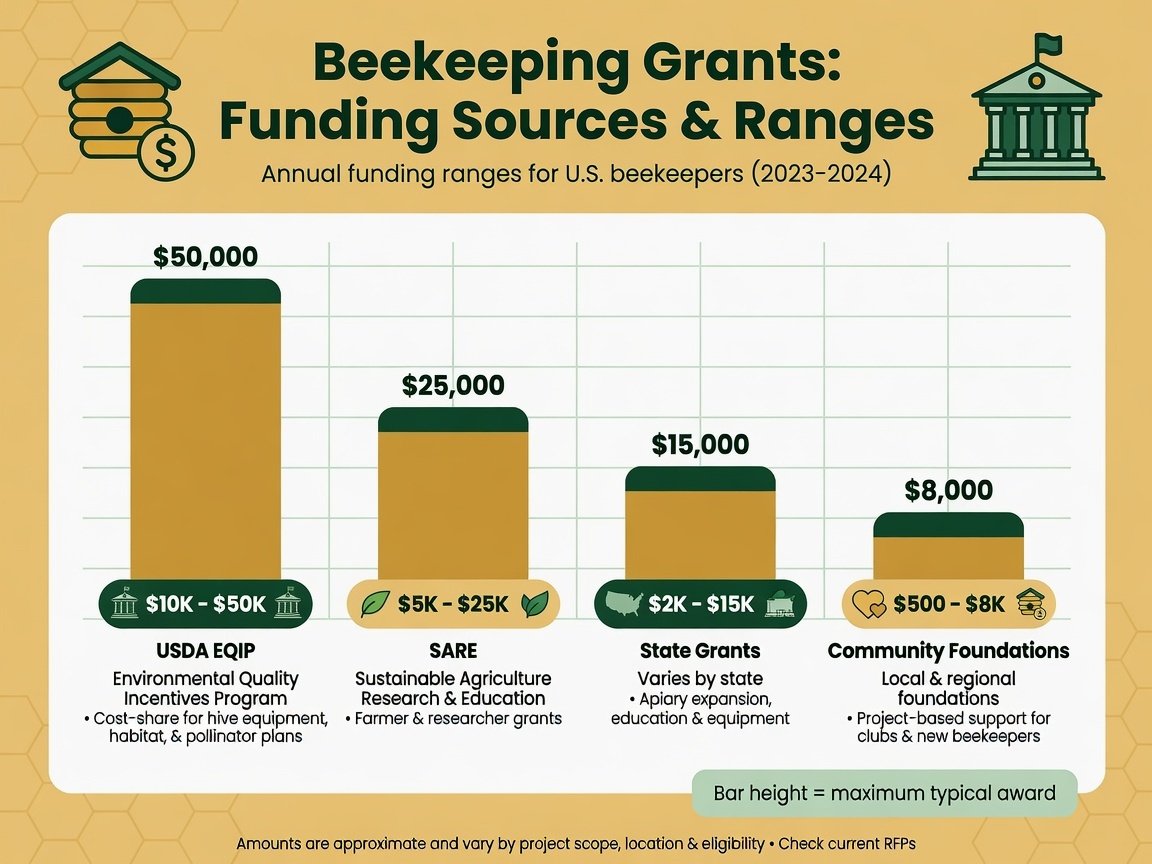
Grant amounts vary widely, and it helps to have realistic expectations going in. Here’s a general overview of what different funding sources typically offer.
| Grant Source | Typical Award Range | Best For |
|---|---|---|
| USDA EQIP | $500 – $10,000+ | Established beekeepers, small farms |
| USDA SARE (Farmer & Rancher) | $7,500 – $30,000 | On-farm research projects |
| State Department of Agriculture | $500 – $50,000 | Varies widely by state |
| Specialty Crop Block Grants | $1,000 – $50,000 | Honey production, marketing |
| Community Foundations | $250 – $2,500 | Beginning beekeepers, education |
| Nonprofit / Private Foundations | $500 – $10,000 | Habitat, conservation, education |
Keep in mind that many programs require a cost-share contribution — typically 25% to 50% of the total project cost. So if you’re applying for a $5,000 grant with a 25% cost-share requirement, you’ll need to demonstrate that you’re contributing $1,250 in matching funds or in-kind resources like your labour or existing equipment. Factor this into your planning before you apply.
What Can You Spend Grant Money On?
Eligible expenses depend on the specific grant program, but most beekeeping grants cover some combination of the following categories.
Equipment and hive supplies are the most commonly covered expense. This includes hive boxes, frames, foundation, protective gear, extraction equipment, and feeding supplies. If you’re just starting out and putting together a realistic startup budget, getting clear on how to source bees for your new hives will help you build accurate cost estimates before you apply.
Pollinator habitat establishment is a major focus for conservation-oriented grants. This covers native seed mixes, wildflower plantings, water sources, and land management practices that support bee health. EQIP in particular pays well for documented habitat improvements on qualifying land.
Training and education expenses are eligible under many programs. Beekeeping courses, certification programs, conference registrations, and educational materials can all qualify. Some grants even cover the cost of bringing an extension apiarist to your property for a consultation and apiary inspection.
Integrated pest management (IPM) tools and treatments are covered under conservation programs like EQIP. This includes varroa monitoring equipment, approved treatments, and record-keeping systems for documenting colony health over time.
Facility improvements such as honey house upgrades, ventilation systems, and food-safe extraction equipment may qualify under certain state or specialty crop programs, particularly if you’re producing honey for commercial sale. Getting a solid grounding in colony nutrition — understanding topics like the basics of feeding your bees — also helps you anticipate ongoing supply costs when putting together your grant budget.
What most grants won’t cover: land purchase, personal income replacement, ongoing business operating expenses, or purchases made before the grant was awarded. Always read the eligible expense guidelines before buying anything you plan to claim.
How Do You Apply for a Beekeeping Grant Step by Step?
The application process feels daunting the first time, but it follows a predictable pattern. Here’s a step-by-step approach that works for most programs.
- Research available programs in your area. Start with your county NRCS office for EQIP, your state’s department of agriculture website, and your cooperative extension office. Make a list of programs you qualify for and note their application deadlines.
- Register your apiary. Many states require apiary registration before you can access grant programs. Contact your state department of agriculture to confirm your registration is current — this is often a required attachment in applications.
- Define your project clearly. Before writing a single word, answer three questions: What specific problem are you solving or improvement are you making? How will you measure success? What will the grant money specifically pay for? Clear answers make strong applications.
- Gather your documentation. Most applications ask for a farm or property description, your current beekeeping operation details (number of hives, years of experience), a project budget with cost breakdown, and your registration or tax ID information.
- Write your project narrative. Connect your project to the grant’s stated goals — pollinator health, sustainable agriculture, food security, or education. Use specific, measurable language. “I plan to establish two acres of native wildflower habitat to support 12 colonies” is stronger than “I want to improve my bees’ forage.”
- Submit before the deadline. Many programs have hard cutoffs with no exceptions. Set a calendar reminder two weeks before the deadline to do a final review. Late applications are routinely rejected regardless of merit.
- Follow up after submission. It’s appropriate to contact the program office two to three weeks after submitting to confirm receipt and ask about the review timeline. This keeps you on the program coordinator’s radar in a professional way.
What Makes a Strong Beekeeping Grant Application?
Grant reviewers read dozens or hundreds of applications. The ones that stand out do a few things consistently well.
They connect to the funder’s mission. NRCS cares about conservation outcomes. SARE cares about sustainable farming research. A community foundation cares about local impact. Your application needs to speak the funder’s language, not just your own. Read the program’s stated goals carefully and mirror them in your narrative.
They include specific numbers. “I currently manage eight hives across two sites and plan to expand to 20 hives while establishing three acres of pollinator forage” is far more compelling than vague claims about growing your operation. Specificity signals credibility and planning.
They demonstrate real knowledge of bees and best practices. Reviewers can tell the difference between someone who has done serious preparation and someone who is brand new. Deepening your knowledge before applying pays dividends — working through a comprehensive resource like a full guide to beekeeping and honey processing builds the kind of foundational understanding that shows in your writing.
They have a realistic, detailed budget. Vague budgets raise red flags. Line-item your costs with realistic prices. If you’re budgeting $800 for two Langstroth hive setups, show the math: two brood boxes at $120 each, two supers at $80 each, frames, foundation, and hardware. That level of detail tells reviewers you’ve actually planned the project.
They show community benefit where relevant. Education-focused grants respond well to plans that involve others — mentoring beginning beekeepers, hosting workshops, partnering with a school or community garden. Even a small ripple effect beyond your own operation can significantly strengthen an application.
Are There Grants Specifically for Beginning Beekeepers?
Absolutely — and this is great news if you’re just starting out. Many programs specifically prioritise new and beginning farmers because supporting entry into agriculture is a stated policy goal at both the federal and state level.
USDA EQIP gives priority ranking to beginning farmers, which means new beekeepers are more likely to have their applications funded in a competitive cycle. The USDA defines a beginning farmer as someone with ten years or fewer of experience as a farm operator — so you have a generous window to claim that status.
State-level beginning farmer programs are another strong avenue. Many state departments of agriculture offer loans, grants, and mentorship through beginning farmer initiatives that include specialty crop producers and beekeepers. Look for your state’s “beginning farmer” or “young farmer” program — the terminology varies but the target audience is the same.
Beekeeping clubs and associations are an underappreciated funding source for beginners. The American Beekeeping Federation and many state associations offer small scholarships, equipment grants, and mentorship connections. Membership dues are typically modest and the networking alone can connect you to funding opportunities that aren’t widely advertised. Some local clubs even maintain loaner equipment programs that let you get started without the full upfront cost.
What Happens After You Receive a Beekeeping Grant?
Getting funded is exciting — but it’s the beginning of a process, not the end. Most grants come with reporting requirements, and meeting them matters for your reputation as a grant recipient and your eligibility for future funding.
Keep detailed records from day one. Document every purchase with receipts, photograph your hive installations and habitat improvements, and maintain a simple project log. Grant administrators will ask for this information, and organised records make your final report much easier to compile.
Interim and final progress reports are standard. Most programs ask for a mid-project update and a final report at project completion. Be honest about what went well and what didn’t — grant administrators appreciate candour, and explaining a setback professionally is much better than glossing over it.
Some programs include site visits. NRCS, for example, routinely sends field staff to verify that funded practices have been implemented as described. This is a normal part of the process — not a sign that anything is wrong — and a well-organised apiary makes a positive impression.
Finally, consider sharing your experience with your local beekeeping community. A brief write-up for your club newsletter, a post on your website, or a short presentation at a regional association meeting builds goodwill and helps other beekeepers discover funding opportunities they might otherwise miss. It also establishes you as an active, credible participant in the beekeeping community — which helps with future grant applications.
Frequently Asked Questions About Grants for Raising Honey Bees
Do I need to be a full-time farmer to qualify for USDA beekeeping grants?
No. USDA EQIP and many other programs are available to part-time agricultural producers and hobby farmers. The key requirement is that your operation has an agricultural purpose — producing honey, renting pollination services, or raising bees for sale — rather than being purely recreational. Even if beekeeping is a side activity alongside other employment, you can qualify if your apiary meets the program’s minimum threshold, which varies by state and program.
Can urban or backyard beekeepers get grants?
Yes, though your options are somewhat narrower than those available to rural beekeepers. Community foundation grants, local beekeeping association scholarships, and education-focused programs are the best fit for urban beekeepers. Some states with urban agriculture initiatives also have funding accessible to city-based producers. If your city or county has an urban agriculture policy, check with your local government’s planning or sustainability office — there may be programs you haven’t heard of yet.
How competitive are beekeeping grants?
Competitiveness varies considerably by program. USDA EQIP applications in states with high agricultural activity can be quite competitive, with priority points making a real difference in how applications are ranked. State-level specialty crop grants are often moderately competitive. Local community foundation grants tend to be less competitive simply because fewer people know about them and apply. Beginning farmer priority status helps significantly in federal programs — if you qualify, indicate it clearly in every application.
Is grant income taxable?
In many cases, yes — grant income is generally considered taxable income for farmers and agricultural producers in the United States, though specific rules vary depending on the program and how the funds are used. USDA cost-share payments have historically been treated differently from other income under certain conditions, but the rules are complex. Always consult a tax professional or your county farm bureau advisor about the tax implications of any grant you receive before filing your return.
Can I apply for multiple beekeeping grants at the same time?
Generally yes, as long as you’re not claiming the same expenses under multiple programs. You can legitimately receive EQIP funding for habitat improvements while also receiving a state specialty crop grant for equipment, because these are different expense categories within different programs. Be transparent in each application about other funding you’ve applied for or received — program coordinators often ask, and concealing it can result in disqualification or clawback of awarded funds.
What if my application is rejected?
Ask for feedback. Most program administrators will tell you why your application didn’t score well, and that information is genuinely useful for your next attempt. Common reasons for rejection include a project narrative that doesn’t clearly connect to the program’s goals, a vague or unrealistic budget, missing documentation, or simply running out of funding in a competitive cycle. A rejected application isn’t a permanent no — it’s often a first draft. Many successful grant recipients were rejected once or twice before they were funded.
Your Next Steps: Starting Your Grant Journey in 2026
The funding is out there — and the barrier to accessing it is lower than most people assume. Here’s a practical timeline to get moving.
- This week: Contact your county NRCS office and your state’s department of agriculture to ask about open or upcoming beekeeping grant programs. Note their deadlines on your calendar.
- Within 30 days: Register your apiary with your state if you haven’t already. Join your state beekeeping association — members often hear about funding opportunities before they’re publicly announced.
- Within 60 days: Draft a one-page project description that explains what you want to do, why it supports pollinator health, and what it will cost. Even a rough draft forces the clarity that makes applications stronger.
- Before the first applicable deadline: Submit your application with complete documentation. Calendar a follow-up reminder for two weeks after submission.
- Ongoing: Keep records of everything — every receipt, every photo, every colony inspection note. These become the raw material for your progress reports and for your next application cycle.
Beekeeping is a skill and a practice that rewards patience — and so is grant-seeking. The beekeepers who consistently access funding aren’t necessarily the ones with the biggest operations. They’re the ones who stay organised, know their local programs, and keep showing up. That’s a game anyone can play.