Varroa mites are the single biggest threat to managed honeybee colonies in the UK, and chemical treatments remain the most widely used tool for keeping mite populations under control. In 2026, UK beekeepers have three main categories of licensed treatment to choose from — organic acids, plant-derived products like thymol, and synthetic treatments — each with its own timing, temperature window, and safe handling requirements that you need to understand before you open the box.
Some of the links in this article may be affiliate links. If you make a purchase through these links, we may earn a small commission at no extra cost to you. Thank you.
- Varroa destructor has been present in UK honeybee colonies since 1992 and is now near-universal in managed colonies without active control
- Three main licensed treatment categories cover UK practice in 2026: organic acids, thymol/plant-derived, and synthetic treatments
- Timing and temperature are decisive — even the right product used at the wrong time or outside label conditions can fail entirely
- Most varroa treatments are classified as veterinary medicines in the UK; record-keeping is both best practice and, for many products, a legal requirement
What Do “Varroa Chemical Treatments” Actually Mean?
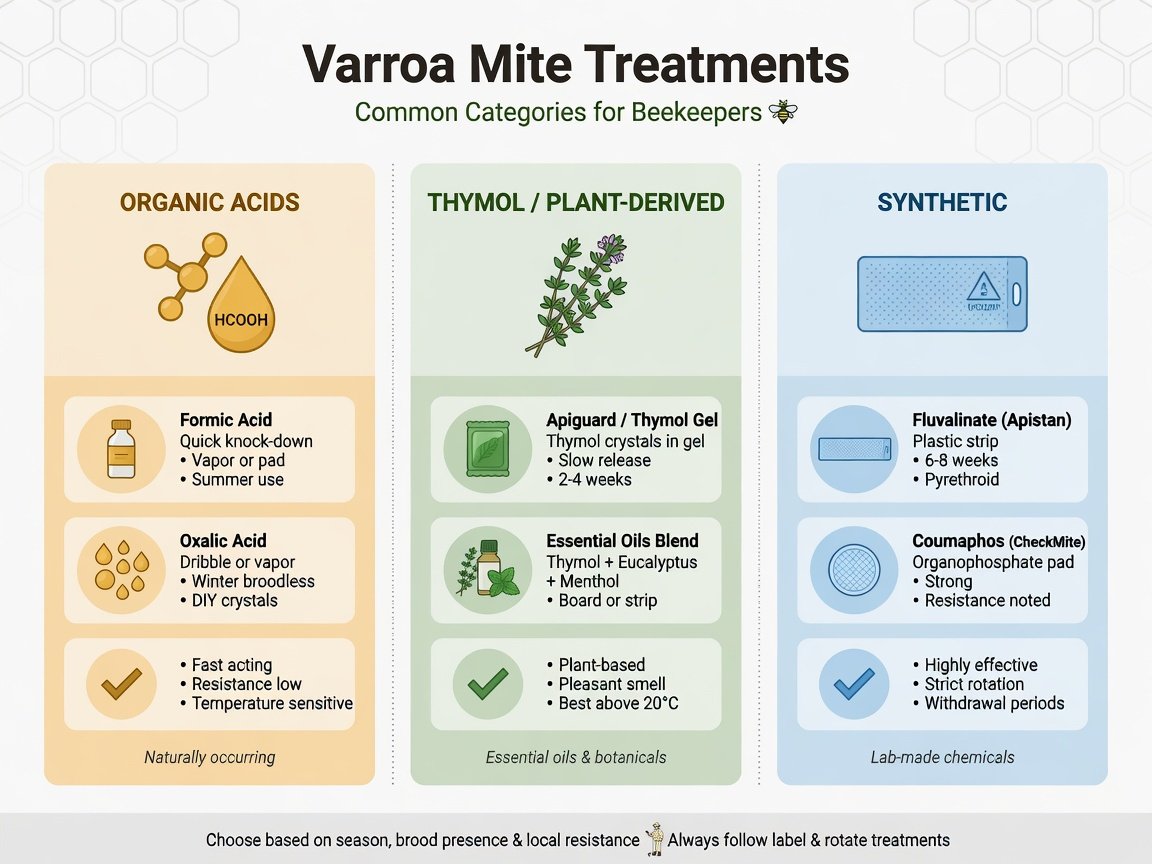
The phrase “chemical treatment” can sound alarming when you’re thinking about your bees, but in a beekeeping context it simply means any licensed product applied to a colony to reduce mite numbers. That umbrella is broader than most people expect. It covers organic acids found naturally in honey, plant-based compounds like thymol derived from thyme oil, and man-made synthetic molecules designed to kill mites on contact. None of these are inherently dangerous when used correctly — but all of them require careful timing, appropriate conditions, and proper handling to work safely and effectively.
What sets these three categories apart from each other is how they work. Organic acids kill mites through direct chemical contact when phoretic mites are sitting on adult bees. Thymol-based treatments work via vapour pressure — the compound slowly evaporates and reaches mites through the bees’ movement around the hive. Synthetic treatments typically work via contact or ingestion when bees move through treated strips or pads. Because each mechanism is different, the conditions required for effectiveness — and the failure modes when they go wrong — differ significantly between categories.
It’s also important to remember that chemical treatments are just one part of a sound varroa management plan. The National Bee Unit (NBU), which oversees bee health policy in England and Wales, consistently emphasises that the best outcomes come from beekeepers who monitor regularly, treat at the right threshold, and integrate chemical controls with biotechnical methods such as brood breaks and comb rotation. NBU guidance published in 2026 reiterates that monitoring before treating — rather than treating on a fixed calendar — leads to better mite control and lower treatment frequency over time.
The Three Main Treatment Categories Used in the UK
Brand names come and go, products get reformulated, and licensing can change. But the underlying treatment categories remain fairly stable. Understanding the category logic — not just which product is currently popular — helps you make better decisions as conditions change through the season. Here’s a plain-English comparison before we go deeper into each one.
| Category | How it typically works | Key constraints | First step before use |
|---|---|---|---|
| Organic acids | Direct contact with mites on adult bees | Most effective with little or no sealed brood; method- and temperature-sensitive | Check current label, assess brood status, and plan timing around the seasonal window |
| Thymol / plant-derived | Vapour-based; mites exposed as bees move through the colony | Temperature range is critical (typically 15–25°C); honey supers must usually be removed first | Check product’s temperature guidance and remove supers if the label requires it |
| Synthetic treatments | Contact or ingestion via treated strips, pads, or other delivery formats | Resistance risk if reused without rotation or applied at incorrect dose | Follow the current label exactly; plan category rotation; never under-dose |
One rule applies to all three categories without exception: the product label is the final authority. Not a beekeeping forum post, not last year’s notes, not a memory of what your mentor used. Products are updated, methods are revised, and authorised usage conditions can change between label editions. Always read the current label for the specific product in your hand before you open it.
Organic Acid Treatments: Powerful When Conditions Are Right
Organic acid-based treatments are among the most widely used varroa controls in the UK, and when conditions align they can be highly effective. Published research consistently reports efficacy rates of over 90% against phoretic (adult-bee-dwelling) mites when treatments are applied in broodless or near-broodless conditions. That figure drops significantly as brood levels rise, which is why timing and brood status assessment aren’t optional extras — they’re central to whether the treatment works at all.
Understanding why brood matters so much helps here. Varroa mites reproduce inside capped brood cells, where they are physically shielded from any treatment applied to the colony. A single mite entering a capped cell can produce one or two viable female offspring per brood cycle. Any treatment that only targets phoretic mites — those currently sitting on adult bees — leaves a large proportion of the total mite population completely untouched if brood is present. The closer you get to a genuinely broodless window, the higher the proportion of mites you can actually reach in a single application.
In practice, the main broodless windows in UK apiaries occur naturally in mid-winter — typically December and January — when the queen reduces or stops laying. Some beekeepers also create artificial brood breaks using a queen cage or an artificial swarm, which produces a temporary broodless period and allows organic acid treatment outside the winter season. Whichever route you take, always check the specific product label for approved application methods, authorised temperatures, and the number of repeat treatments permitted per course.
Safe handling is non-negotiable for organic acid products. Many application methods — particularly vapourisation — generate concentrated vapours or fine aerosols that can cause serious irritation to eyes, airways, and skin. The PPE specified on the label for the specific product and application method you’re using isn’t optional. For most organic acid applications this includes chemical-resistant gloves, eye protection, and respiratory protection at a minimum. Always have your full PPE on before you begin — not partway through.
Thymol and Plant-Derived Treatments: A Late-Summer Staple
Thymol-based products have been a fixture of UK late-summer varroa management for decades. Thymol is derived from thyme oil, which makes it feel more “natural” to many beekeepers — and technically it is. But don’t let that natural origin lull you into handling it any less carefully than other products. Thymol is a volatile compound that works by releasing vapour slowly over the treatment period, reaching mites through the bees’ constant movement around the hive and nest. That same volatility is exactly why temperature is so critical to its effectiveness.
Most thymol product labels specify a working temperature range of approximately 15°C to 25°C. Below the lower limit, the product doesn’t evaporate fast enough to reach effective concentrations in the colony air space. Above the upper limit, it evaporates too quickly — the treatment period is shortened and the colony can be stressed by excessive vapour. In the UK, this window puts thymol treatments firmly in the late summer and early autumn period, typically from early August through to mid-October, though this varies by product and local climate.
The other non-negotiable for most thymol products is honey handling. The vast majority of licensed UK thymol treatments require all honey supers to be removed before treatment begins, because thymol can taint honey. Many products also specify a minimum period after treatment ends before supers can be returned. This catches a lot of beekeepers out, especially in seasons with a prolonged ivy flow running into October. Always check the specific product’s requirements — don’t assume they’re the same across different thymol brands or formulations.
A follow-up mite count after treatment is strongly recommended. A mite wash performed three to four weeks after the treatment period ends confirms whether the treatment hit its target. If counts remain elevated, you still have time in October or early November to assess whether a supplementary or alternative treatment is needed before the colony forms its winter cluster. Waiting until spring to discover the treatment didn’t perform as expected means losing the critical late-season protection window entirely.
Synthetic Treatments: Effective — but Rotation Matters
Synthetic varroa treatments — including compounds from the pyrethroid and amidine families — can be highly effective where local mite populations remain susceptible to them. They are typically applied via plastic strips impregnated with the active ingredient, which bees contact as they move through the brood frames. The treatment period runs for several weeks, allowing sustained exposure across a full brood cycle. When conditions are right and the mite population is susceptible, synthetic treatments can produce strong knockdown results.
The resistance problem is real, well-documented, and has been present in UK apiaries for over two decades. Resistance to synthetic pyrethroid treatments — such as tau-fluvalinate — was first confirmed in UK mite populations in the early 2000s and has been spreading geographically ever since. Where resistance is established, these treatments may show little or no effect on the mite population even when applied correctly and at the full dose. This doesn’t make synthetics useless — but it makes understanding your local resistance picture, and planning rotation accordingly, essential.
Under-dosing is one of the fastest routes to accelerating resistance. When a mite population is exposed to an insufficient dose, the most susceptible mites die while resistant individuals survive and reproduce, passing their resistance traits to the next generation. This is why following label dosing precisely, completing the full treatment period without removing strips early, and using the correct number of strips for the colony size all matter beyond this season’s mite count. It’s about preserving the effectiveness of these products for future seasons as well.
Seasonal Timing: Matching Treatment to the Colony’s Calendar
Varroa management in the UK is fundamentally seasonal. The colony’s biology changes dramatically across the year — brood levels rise and fall, the ratio of phoretic to brood-phase mites shifts, and temperature ranges determine which treatment categories are viable at any given point. Even the most effective treatment, applied at the wrong time, can fail to protect the colony when it matters most. Here’s how the four main seasonal windows map out for UK beekeepers.
| Season | What’s happening in the colony | Why timing matters | Typical management approach |
|---|---|---|---|
| Spring | Brood expansion accelerates from February; colony rebuilding strongly by April | Mite populations can double every four to six weeks at peak brood season — a small winter population can become a serious burden by June if unchecked | Monitor via regular mite washes; use biotechnical controls where appropriate; plan ahead for the post-harvest treatment window |
| Summer (honey flow) | Supers on; colony at or near peak strength; maximum foraging activity | Most chemical treatments cannot be used with supers on; mite pressure builds steadily through June and July while treatment options are limited | Monitor closely; note when mite loads start climbing; prepare for prompt treatment when supers come off |
| Late summer / early autumn | Supers removed; winter bees being raised from late July/August; colony beginning to contract | The most critical window — mites infesting winter bee larvae transmit viruses that shorten the bees’ lifespan; a healthy winter cohort is essential for colony survival | Treat promptly after super removal; use thymol or organic acid depending on conditions and brood status; follow up with a mite count 3–6 weeks after treatment ends |
| Mid-winter | Colony clustered; little or no brood (typically December–January in most UK apiaries) | The highest proportion of the mite population is now phoretic — sitting on adult bees — and accessible to organic acid treatment | Apply a suitable organic acid treatment in the broodless window; this is often where the highest mite knockdown rates of the year can be achieved |
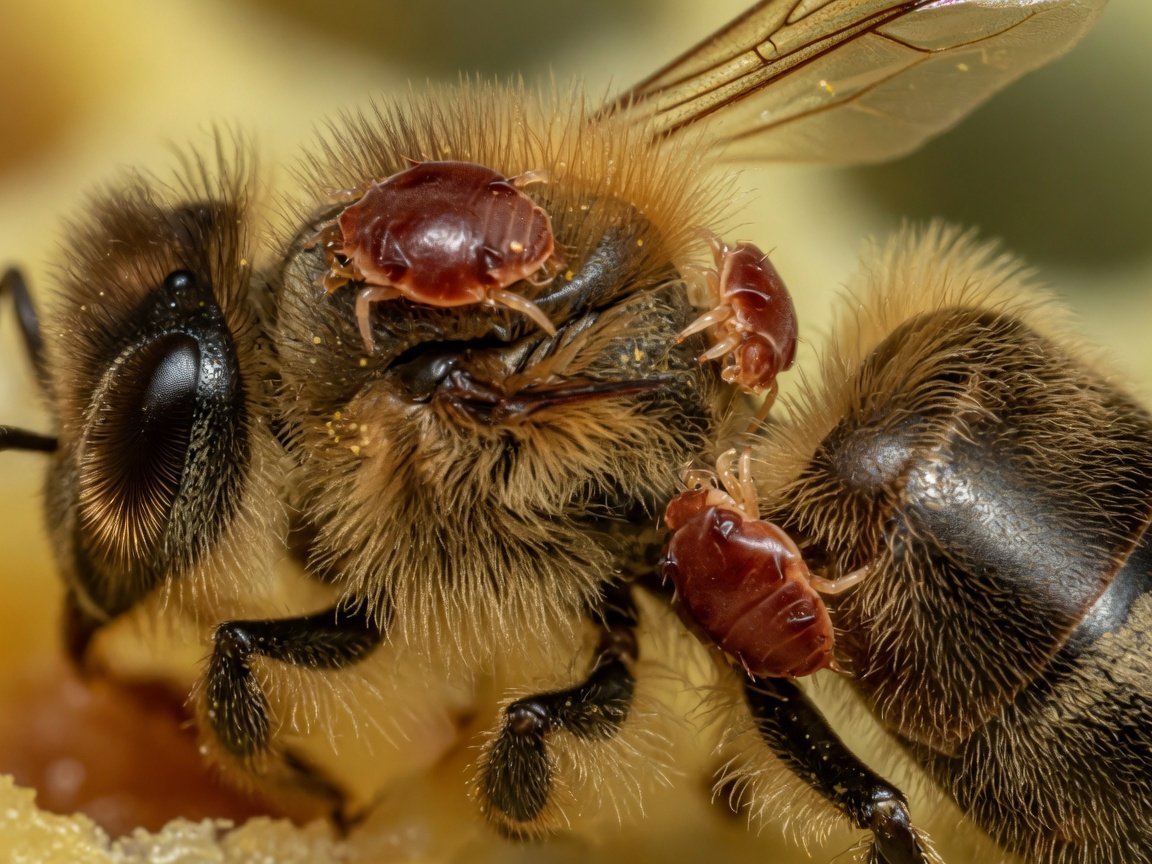
The late-summer window deserves special emphasis. The bees raised in August and September — commonly called “winter bees” — are physiologically distinct from summer foragers. They accumulate fat reserves, live for several months rather than a few weeks, and provide the warmth and food processing capacity that carries the colony through to spring. Varroa mites infesting winter bee larvae transmit viruses, most notably deformed wing virus, that compromise these bees’ longevity and fat-body development. A colony heading into winter with a high viral load in its winter bee cohort often fails to reach March — not because it ran out of stores, but because the bees died too young. Protecting the late-summer treatment window is protecting the colony’s survival.
Why Resistance Develops — and How to Prevent It
Resistance is an evolutionary response, not a product defect. Every time a treatment is applied, it creates selection pressure on the mite population: the most susceptible mites die, and the most resistant ones survive and reproduce. Over successive generations, those resistant traits become dominant. This process can’t be stopped entirely, but it can be slowed significantly — and beekeepers who understand the mechanisms are far better placed to manage the risk over the long term.
Four practices are most strongly associated with accelerating resistance in UK apiaries:
- Using the same treatment category repeatedly without rotation — this is the primary driver, providing consistent one-directional selection pressure on the mite population
- Under-dosing or removing treatment early — insufficient exposure kills susceptible mites but allows resistant individuals to survive and breed
- Treating in unsuitable conditions — applying a product outside its specified temperature range or brood status requirements reduces efficacy while still applying selection pressure
- Treating without monitoring or follow-up counts — means you may be repeating a failing approach for seasons without realising it
The positive counterpart to this list is equally clear. Rotate treatment categories between main treatment cycles — not just brands within the same category. Always use the correct dose for the colony size as specified on the label. Treat when monitoring data justifies it, rather than on a fixed calendar. And conduct a follow-up mite count after every treatment to confirm it worked. These four habits, consistently applied, are the most practical and available defences against resistance development for UK beekeepers in 2026.
Safe Handling and PPE: The Step You Can’t Shortcut
Safe handling protects you, your bees, and your honey crop. Every licensed varroa treatment specifies PPE requirements on its label — and those requirements exist because the product’s risk assessment concluded that protection is necessary at realistic exposure levels. “I’ve done it without gloves for years” is not a safety argument; it’s a description of accumulated uncontrolled exposure. The label’s PPE requirements are non-negotiable minimums, not suggestions you can weigh up on the day.
PPE requirements vary by product and application method — there’s no single universal list. However, for most licensed varroa treatment applications in the UK, you should expect to need some combination of the following:
- Chemical-resistant gloves — standard leather or fabric beekeeping gloves may not provide the required protection; check the label for the specified glove material, often nitrile or neoprene
- Eye protection — safety glasses or goggles at minimum; for vapourisation applications a full-face shield may be specified
- Respiratory protection — a minimum FFP2 or FFP3-rated filtering facepiece, or a half-face respirator with appropriate cartridges; required for most vapourisation and trickling methods
- Protective clothing — covering arms and legs to minimise skin contact; your standard beekeeping suit is usually adequate for this element
Preparation before you get to the apiary is as important as the PPE itself. Read the full product label before treatment day — not on the morning. Check the temperature forecast for the treatment period. Make sure your application equipment is clean, in working order, and appropriate for the method specified. Have a plan for safe storage and disposal of unused product and packaging. Rushing this stage is one of the most common causes of both treatment failure and personal exposure incidents.
Record Keeping: What to Write Down and Why It Matters
Good record keeping is more than administrative box-ticking. For most licensed varroa treatments, maintaining treatment records is a legal requirement under UK veterinary medicine regulations — not optional best practice. The records exist to protect food safety for honey and beeswax, to ensure treatments are used only as authorised, and to create an audit trail that protects you as the beekeeper if questions arise later. They also make you better at the job.
At minimum, your treatment records should include:
- Date(s) of treatment start and end
- Hive or colony identifier
- Full product name and active ingredient
- Batch number (printed on the packaging)
- Quantity or dose applied, as specified on the label
- Application method used
- Temperature and weather conditions during the treatment period
- Observations — brood status at treatment time, colony size, any handling issues
- Follow-up mite count result (date and count per 100 bees)
Records also become a practical planning tool over time. Comparing your late-summer and winter treatment logs year-on-year — alongside your pre- and post-treatment mite counts — reveals whether your timing is improving, whether a particular treatment category is still performing well in your apiary, and which colonies manage mite pressure better than others. Many UK beekeepers use a dedicated hive management app such as HiveTag, or a simple spreadsheet, to maintain consistent records across the season. The format matters less than the habit.
Step-by-Step: How to Choose and Apply the Right Varroa Treatment
If you’re working through your varroa treatment plan for the season and aren’t sure where to start, this nine-step sequence gives you a practical decision process that applies at any point in the year. It also reflects the approach recommended in NBU training materials and current BBKA guidance for 2026.
- Conduct a mite wash. Perform an alcohol wash, oxalic acid wash, or sugar roll to establish your actual mite load per 100 bees. The NBU advises treating when counts reach three or more mites per 100 bees during the active season. Don’t estimate — count. Treatment decisions based on guesswork are frequently wrong in both directions.
- Assess your seasonal window. What time of year is it? Are supers on or off? What is the current brood status — full, reducing, or broodless? These three factors immediately narrow down which treatment categories are viable right now.
- Check the temperature forecast. Look ahead four to eight weeks, not just at today. If you’re considering thymol, will temperatures stay within the product’s required range? If you’re planning an organic acid application, is the minimum temperature threshold reliably met?
- Review your rotation history. What category did you use last time? Have you been using the same category for more than one consecutive main treatment cycle? If so, this is the season to rotate. Changing brand within the same category is not the same as rotating categories.
- Read the current product label. Not a memory, not a forum recommendation — the actual current label in your hand. Check the authorised application method, dose, temperature range, PPE requirements, and any withholding periods for honey or wax.
- Assemble your PPE and equipment before you leave for the apiary. Gather everything the label specifies. Confirm application equipment is clean and functioning. Don’t start treatment and then discover you’ve left your respiratory protection in the shed.
- Apply at the correct dose for the full treatment period. Don’t remove strips or blocks early. Don’t reduce the number of strips to save product. Don’t treat in conditions outside the label’s specified range. Apply exactly as instructed and complete the full course.
- Conduct a follow-up mite count. Three to six weeks after the treatment period ends, perform another mite wash. Compare pre- and post-treatment counts to assess knockdown. If mite counts remain elevated, investigate why before considering retreatment.
- Record everything immediately. Don’t wait until the end of the season. Note the date, product, dose, batch number, conditions, colony ID, and follow-up result before you leave the apiary, while the information is accurate and fresh.
A practical illustration of what this looks like over time: a group of beekeepers affiliated with a BBKA branch in the East Midlands shifted from a single late-summer thymol treatment to a two-stage annual protocol — thymol in August followed by an organic acid application in the broodless winter window. Over three successive seasons, their combined average colony loss rate fell from approximately 24% to around 9%. No single change accounts for the full improvement, but the combination of consistent late-summer timing, broodless-window treatment, category rotation, and systematic follow-up monitoring was credited by the beekeepers as the key driver of that outcome.
Frequently Asked Questions About Varroa Chemical Treatments in the UK
Are varroa chemical treatments safe for my bees?
Authorised treatments are designed and tested for use according to their label conditions, and risk to bees at the correct dose in the correct conditions is minimal. Risk rises when products are applied outside those conditions — wrong temperature, wrong dose, wrong timing, or with honey supers on when the label prohibits it. For perspective: untreated varroa infestations are reliably fatal to colonies within two to three years as mite-transmitted viruses accumulate. The risk of correct treatment is far lower than the near-certainty of unchecked infestation.
Can I treat with my supers on?
It depends entirely on the specific product. Most thymol-based treatments require supers to be removed before treatment begins because thymol can taint honey — a food safety issue. Organic acid products have their own rules, as do synthetic strip treatments. There is no blanket answer. Always check the current label for the product you’re holding. Treating with supers on when the label prohibits it is both a food safety issue and a breach of the product’s authorised use conditions.
How do I know which treatment to choose?
Start with your seasonal window and colony brood status, then work backwards to a viable category. Organic acids are most powerful in low-brood or broodless conditions. Thymol needs temperatures in the 15–25°C range and supers off. Synthetics can be used across a wider temperature range but require rotation to stay effective. Your local bee inspector or beekeeping association can advise on what’s currently working in your specific area, including any confirmed local resistance issues.
How often should I treat for varroa?
There’s no fixed schedule that works for all colonies in all locations. Treatment frequency should be driven by your monitoring data. Most UK beekeepers aim for at least one main treatment in late summer — to protect winter bees — and a second in the broodless winter window, to reduce mite carry-over. Some colonies in high-pressure locations or difficult years may need additional intervention. Monitor regularly, treat at threshold, and always confirm with a post-treatment count.
Do I legally have to keep treatment records?
Yes — for most licensed varroa treatments, record keeping is a legal requirement under the UK Veterinary Medicines Regulations, not just best practice. At minimum, record the treatment dates, colony identifier, product name and batch number, dose applied, and conditions during treatment. Your local bee inspector can confirm the specific requirements for any product you’re unsure about. Consistent records also make you a significantly more effective beekeeper by allowing season-on-season comparison of outcomes.
What PPE do I need for varroa treatments?
PPE requirements are product-specific and listed on each product’s label. At minimum, most licensed UK varroa treatments require chemical-resistant gloves and eye protection. Vapourisation application methods additionally require respiratory protection — typically an FFP2 or FFP3-rated mask or a half-face respirator with appropriate cartridges. Standard beekeeping gloves may not provide adequate chemical resistance; check the label for the required glove specification. Always put on your full PPE before beginning application, not after you’ve already started.
My treatment doesn’t seem to be working — what should I do?
Don’t just reapply the same product. First, conduct a post-treatment mite wash to confirm that the treatment is actually underperforming rather than your impression being based on visual observation alone. If counts remain high after correct application, resistance may be a factor — particularly if you’ve used the same treatment category for several consecutive years. Speak to your local bee inspector before applying a second course. Repeating a failing treatment risks worsening the resistance situation rather than resolving the mite problem.
Your 2026 Varroa Treatment Action Plan
Varroa management doesn’t have to be complicated — but it does have to be consistent. The beekeepers who lose the fewest colonies aren’t necessarily those with the newest products or the most elaborate protocols. They’re the ones who monitor reliably, treat at the right moment with the right product, handle everything safely, and keep clear records that let them improve each season. That combination of habits is available to every beekeeper, regardless of experience level.
Looking ahead to the next 12–24 months, a few developments are worth tracking. The VMD continues to review applications for novel varroa control products, including extended-release organic acid formulations that aim to address the brood-phase mite problem — the area where all current treatments have the greatest limitation. Digital monitoring tools, including acoustic sensors and image-recognition-based mite counting systems, are advancing quickly; several are already in commercial use and may become practical options for more UK beekeepers within the next two to three years. Meanwhile, pyrethroid resistance continues to spread geographically, making rotation habits increasingly important even in areas where resistance hasn’t yet been confirmed locally. Building good rotation practice now, before resistance arrives in your apiary, is far easier than trying to reverse the situation after the fact.
Here’s a practical timeline for the rest of 2026 and into the first half of 2027:
| Timeframe | Recommended action |
|---|---|
| October 2026 (now) | Conduct a mite wash on every colony; confirm late-summer treatment was effective; assess whether any follow-up treatment is needed before the colony clusters for winter |
| November–December 2026 | Monitor brood levels colony by colony; plan the timing of winter organic acid treatment for when each colony reaches a broodless or near-broodless state; review rotation history and confirm planned winter treatment category |
| December 2026 – January 2027 | Apply winter organic acid treatment in the broodless window; check colony by colony — not all colonies become broodless simultaneously; record all treatment details including date, dose, conditions, and batch number |
| February–March 2027 | Conduct post-winter mite counts as brood rearing resumes; assess colony health going into spring; note any colonies with elevated post-treatment counts for monitoring priority through the season |
| July–August 2027 | Remove honey supers promptly when flows end; conduct a pre-treatment mite count; apply your late-summer treatment — rotating the category from your 2026 late-summer choice; target treating before mid-August to protect the early winter bee cohort |
| September 2027 | Follow-up mite wash three to six weeks after late-summer treatment ends; confirm effectiveness; update records; plan winter treatment category for 2027/28 in advance |
At rwgreeff.com, we’ll continue publishing practical, label-led beekeeping guidance to help UK beekeepers make well-informed decisions at every stage of the varroa management year. If you have questions about a specific product or treatment situation, your first calls should always be the current product label and your local bee inspector — both are freely available, and both are far more authoritative for your specific location and colony conditions than any general guide can be.