Found dead or crawling bees piling up at your hive entrance? Pesticide poisoning could be the cause. The key signs are a sudden, large-scale die-off — often appearing overnight — with bees trembling, spinning, or unable to fly. If you see this pattern, especially after nearby spraying, here’s exactly what to do.
Some of the links in this article may be affiliate links. If you make a purchase through these links, we may earn a small commission at no extra cost to you. Thank you.
- Pesticide poisoning typically shows as a sudden, large-scale die-off — not a gradual one. It often affects multiple colonies in the same apiary at once.
- Key signs include trembling, spinning, crawling, inability to fly, and in some cases dead bees with extended tongues at the entrance.
- The National Bee Unit (NBU) is the UK authority for investigating suspected poisoning incidents — contact them before disturbing any evidence.
- Other causes — including varroa, starvation, and disease — can look similar. Thorough records are your most powerful tool for distinguishing the cause.
- Many colonies can recover if the queen and nurse bees survive. Calm, methodical action in the first few hours gives the best chance of a good outcome.
What Is Pesticide Poisoning in Bees, and Why Is It a Growing Concern in 2026?
Pesticide poisoning happens when bees come into contact with toxic chemicals — by foraging on treated crops, collecting contaminated nectar or pollen, drinking from puddles near sprayed fields, or being hit directly during a spraying operation. The effect can be either acute (rapid, obvious deaths) or sub-lethal (slower, harder-to-see damage to navigation, memory, and colony behaviour that adds up over time).
Honeybees are remarkably wide-ranging foragers. Research consistently confirms they can travel up to 3 miles (5km) from the hive in search of food, which means your colony can be exposed to pesticides used across a vast area of farms, gardens, orchards, and parks — well beyond anything you can directly observe or control from the apiary.
The issue has sharpened considerably in recent years. The UK government has approved emergency authorisations for the neonicotinoid thiamethoxam on sugar beet for multiple consecutive years, despite wider restrictions on outdoor neonicotinoid use — a decision that has drawn significant criticism from beekeeping organisations and wildlife bodies. According to Pesticide Action Network UK, more than 300 pesticide products registered for use in the UK carry advisory labels warning of bee toxicity. That represents an enormous volume of potential exposure across any normal flying season.
For beekeepers thinking carefully about where to site their hives, understanding the local agricultural landscape really does matter. If you’re acquiring bees for the first time, it’s worth researching nearby land use and the scale of arable farming in your area before committing to a site.
What Are the Main Signs of Pesticide Poisoning in Bees?
The most striking feature of pesticide poisoning is the speed of it. A colony can look perfectly normal one afternoon and have a pile of dead or dying bees at the entrance the next morning. If you see any combination of the following, pesticide poisoning should be high on your list of possible causes:
- Large numbers of dead bees at the entrance — scattered across the landing board, in the grass, or on the ground in front of the hive
- Crawling, trembling, or spinning bees — bees moving abnormally, unable to coordinate movement, circling erratically on the ground
- Bees that can’t fly — they may attempt to launch but fall back, tumble, or simply drag themselves forward
- Dead bees with extended tongues (proboscis) — sometimes mentioned in relation to poisoning, though not proof on its own
- A sudden drop in flying activity — if large numbers of foragers are lost away from the hive, the colony can go unexpectedly quiet even on a good flying day
- Multiple colonies affected at once — this is one of the most significant flags. It points strongly towards a common exposure event rather than an isolated colony problem
No single sign is definitive on its own. The wider pattern is what counts. A handful of dead bees outside a hive on a warm day is entirely normal — thousands of bees die and are removed every day in a healthy colony. But a sudden, large-scale event affecting several colonies simultaneously, coinciding with nearby crop treatment or spraying, is a very different picture that demands prompt attention.
“The sudden loss of large numbers of foragers is often the first thing beekeepers notice. The colony can go from strong and active to eerily quiet within 24 hours. That pattern — rapid onset, multiple colonies affected, recent chemical use nearby — should always trigger contact with your local bee inspector.”
— National Bee Unit (NBU), BeeBase Guidance for BeekeepersIt’s also worth watching for a sudden drop in colony weight if you use hive scales. Losing a large forager workforce overnight registers clearly in the data before you even lift the roof. Some beekeepers notice something is wrong through an overnight weight drop alert before they’ve had a chance to visit the apiary in person.
What Does Pesticide Poisoning Actually Look Like at the Hive?
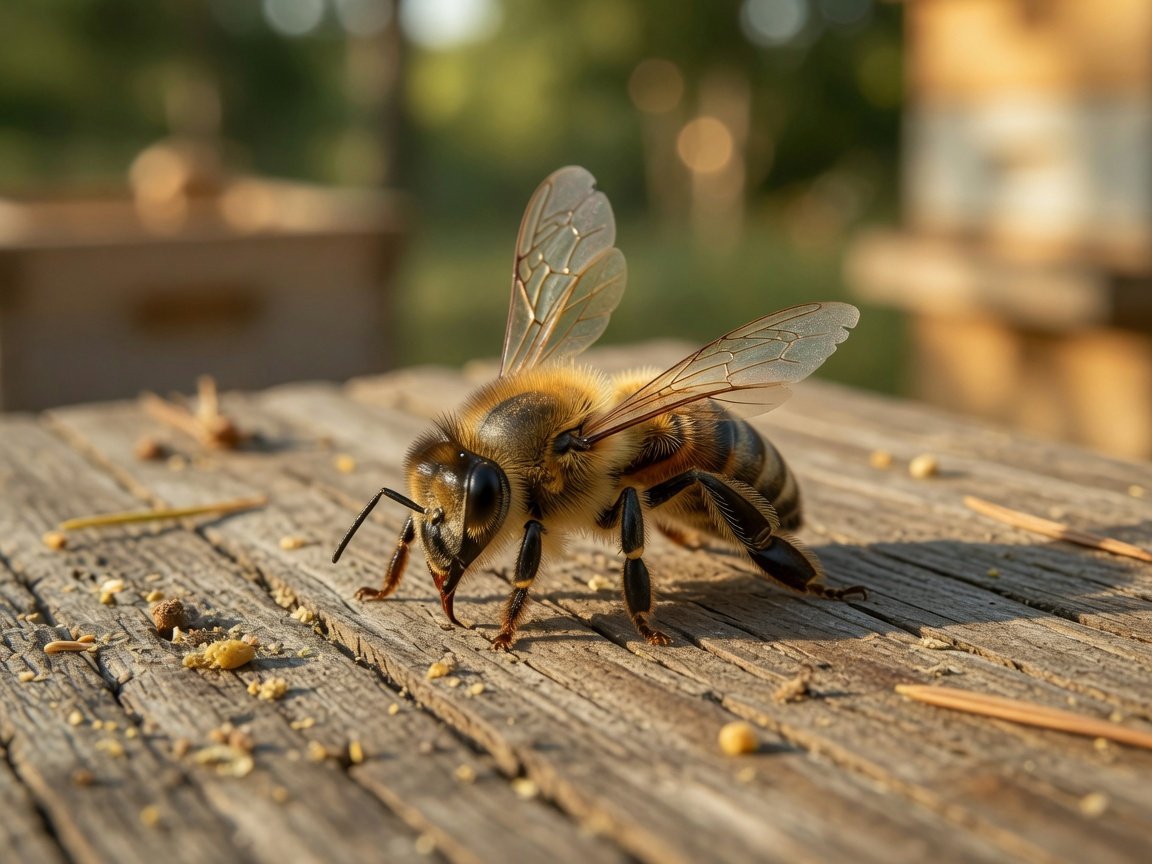
At the entrance, you may find bees scattered across the landing board and the ground nearby — some completely still, others still moving weakly. Guard bees may be actively trying to remove affected bees from the entrance area, which can add to the pile-up outside. The bees that are still alive but affected have a very distinctive quality to their movement: they stagger, tumble, or spin rather than walking or flying purposefully.
You might see bees that appear to be trying to fan their wings but can’t achieve lift-off, or bees that leap and immediately fall back. This kind of disrupted coordination — technically a neurological effect from contact insecticides — looks quite different from the weak, slow crawling associated with Deformed Wing Virus or a colony running out of food. If you’ve seen the difference once, you tend to remember it.
Inside the hive, the picture is more variable. Some poisoned colonies still have healthy, intact brood and a laying queen — they’ve simply lost a significant proportion of their forager workforce. Others, where the exposure was severe or the colony was already under stress, may show more widespread decline. A colony already weakened by varroa, disease, or low stores is much more likely to tip into full collapse after what might otherwise have been a survivable poisoning event.
One detail beekeepers frequently mention is the extended tongue (proboscis) on dead bees. It does appear in some poisoning cases and is often cited in online discussions as a definitive sign. In practice, it’s more nuanced — extended tongues can occur for other reasons, and their absence doesn’t rule anything out. Treat it as one piece of the puzzle, not the whole picture.
Which Pesticides Pose the Greatest Risk to UK Bees in 2026?
Not all pesticides carry the same level of risk to bees, but several broad classes are particularly harmful. Understanding the main culprits helps you think about what might have caused a suspected incident in your area.
Neonicotinoids
Neonicotinoids — including imidacloprid, clothianidin, and thiamethoxam — are systemic insecticides that work by binding to insect nervous systems. They’re highly effective on pest insects, but bees are insects too. Research has consistently found that even sub-lethal doses impair bee navigation, learning, and memory. A 2024 meta-analysis of published research found that field-realistic neonicotinoid exposure reliably reduced honeybee foraging efficiency and significantly lowered bumblebee colony queen production — effects that ripple through colony health long after the initial exposure.
“The evidence that sub-lethal neonicotinoid doses impair bee cognition and colony performance is now extremely robust. The fact that these chemicals continue to receive emergency authorisations for outdoor use in the UK, year after year, is deeply frustrating for anyone who has read the research carefully.”
— Professor Dave Goulson, Professor of Biology, University of Sussex, and author of A Sting in the TaleIn 2026, neonicotinoid use remains a live controversy in UK beekeeping circles. While outdoor use is broadly restricted, emergency authorisations have been granted for specific crops in consecutive years, and seed dust from drilling operations is a documented route of bee exposure during early spring — right when colonies are building up after winter and foragers are actively seeking early pollen sources.
Pyrethroids
Pyrethroids are widely used in gardens, agriculture, and amenity spaces and remain highly toxic to bees on direct contact. They can persist on foliage for several days after application. Studies examining pesticide residues in UK honeybee wax have found pyrethroid compounds present in a large proportion of samples, suggesting widespread low-level background exposure across the UK bee population. They’re particularly risky when applied to flowering plants or when spray drift reaches foraging bees during application.
Organophosphates
Organophosphate insecticides can cause rapid, acute poisoning in bees and act in a similar way to neonicotinoids — disrupting the nervous system — but effects can appear even faster. They’re less commonly used than pyrethroids in modern UK agriculture but are still in use for certain applications. It’s also worth noting that fungicides, while less directly toxic, can interact with other pesticide residues in ways that significantly amplify combined toxicity — a phenomenon called synergistic toxicity that is increasingly studied in the context of bee health.
How Do You Tell the Difference Between Pesticide Poisoning and Other Colony Problems?
This is genuinely one of the harder parts of diagnosing a sudden die-off. Several common problems produce symptoms that can look similar at first glance. Here’s a comparison of the key distinguishing features:
| Feature | Pesticide Poisoning | Varroa / Virus Collapse | Starvation | Robbing |
|---|---|---|---|---|
| Speed of onset | Sudden — often overnight | Gradual, over weeks or months | Gradual, or sudden in cold snaps | Can escalate quickly during dearth |
| Which bees are affected | Mainly foragers; nurse bees in severe cases | Crawling young bees, bees with deformed or missing wings | Dead bees, cluster found in empty frames | Dead bees at entrance from fighting |
| Type of movement | Trembling, spinning, circling, unable to fly | Weak crawling, dragging damaged wings | Sluggish, weak, unresponsive | Frantic activity, fighting at entrance |
| Multiple colonies? | Often yes — same apiary, same time | Gradual spread across weakest colonies | Weakest or smallest colonies first | Targeted at the weakest hive |
| Obvious nearby trigger? | Often — spraying, crop treatment, drilling | No obvious external trigger | No forage, poor earlier feeding | Dearth period, weak colony scent |
| Brood condition | Often intact, healthy brood initially | Patchy, deformed wing virus present, sacbrood | Dead bees head-first in empty cells | Often intact; honey being rapidly removed |
| First action | Photograph, record, contact NBU | Alcohol wash or sugar roll mite count | Check stores, emergency feed if needed | Reduce entrance, identify source colony |
The crucial distinction almost always comes down to speed and pattern. Varroa collapse creeps up over weeks — you usually see deformed wings, a shrinking adult population, and struggling brood long before the final crash. Pesticide poisoning tends to be abrupt: the colony was fine yesterday, and it isn’t today. That sudden switch is the clearest signal that something acute has happened.
“Sudden die-offs are always alarming, and the cause isn’t always what it first appears to be. A methodical approach — checking varroa levels, reviewing stores, considering recent treatments, and then examining whether chemical exposure is plausible — gives a much cleaner picture than leaping straight to one explanation.”
— British Beekeepers Association, Official Colony Health Investigation GuidanceWhat Should You Record Immediately If You Suspect Pesticide Poisoning?
The evidence gathered in the first few hours is irreplaceable. Once dead bees have been cleared, rain has washed the scene, or conditions have changed, much of what an investigator would need is simply gone. Here’s a practical step-by-step recording process to follow as soon as you suspect a poisoning incident:
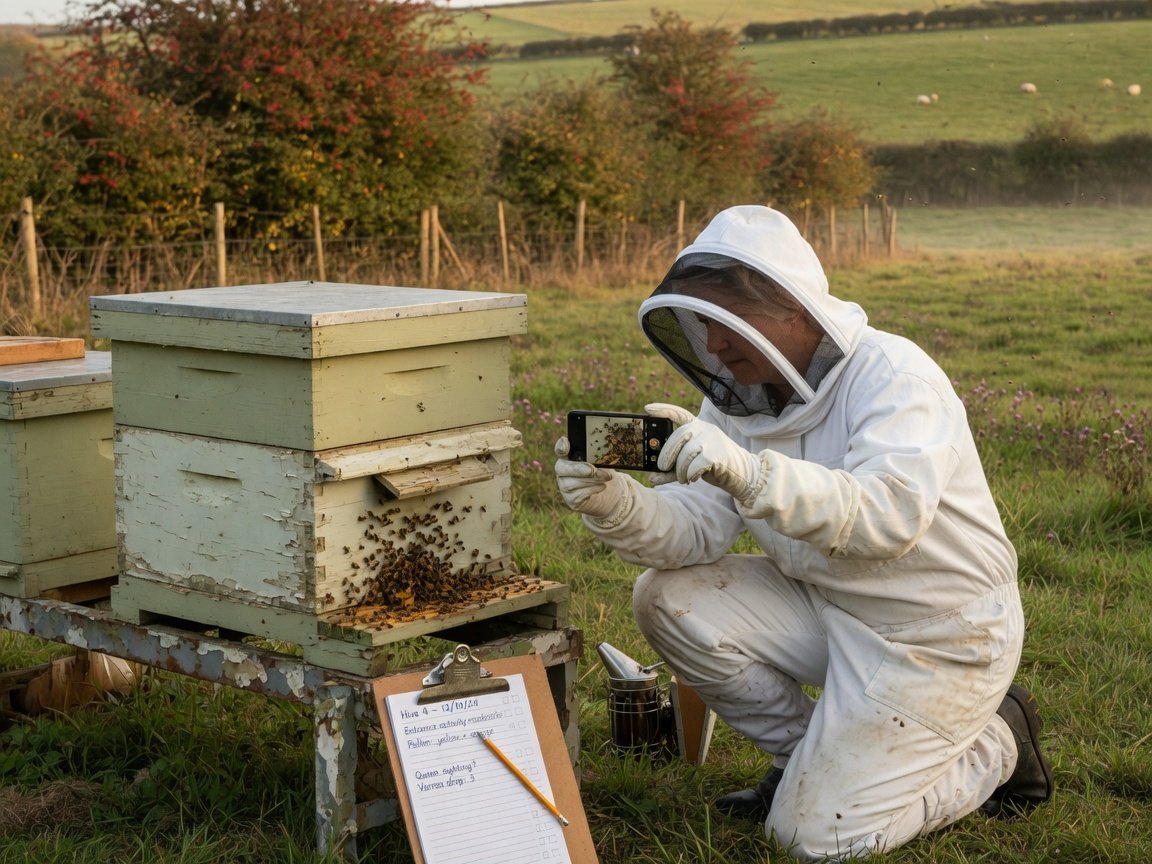
- Photograph everything before touching anything. Capture the hive entrance, landing board, dead bees on the ground, the wider apiary, and any bees showing abnormal behaviour. If more than one colony is affected, photograph each entrance separately so the pattern across the apiary is clear.
- Write down the time and date immediately. Note when you first noticed the problem and, if you can recall, when the colony last appeared normal. A clear timeline is far more useful than an approximate one.
- Record the weather conditions. Temperature, cloud cover, and wind direction all matter. Warm, calm flying weather makes pesticide exposure more likely; cold, wet conditions shift suspicion towards starvation or other causes.
- Note which colonies are affected — and to what degree. Write down hive names or numbers, approximate numbers of dead or affected bees, and whether all colonies are equally affected or some worse than others.
- Describe the bees’ behaviour precisely. Are they dead? Trembling? Spinning? Crawling away from the hive? Unable to fly? Being removed by guard bees? The more specific your description, the more useful it is.
- Record recent colony history. Was this colony previously strong and healthy? Any recent varroa treatments, feeding, or inspections? Any known mite pressure, brood problems, or earlier starvation events? Context shapes interpretation.
- Note any nearby activity factually. Record any spraying, drilling, crop treatment, or chemical use you’re aware of nearby — without accusation or speculation. A factual observation is far more valuable than a rushed conclusion.
- Contact your local bee inspector or the NBU before doing anything else. Don’t move frames, transfer bees, or attempt to collect samples until you’ve spoken to someone with authority to advise on what the investigation needs.
A timestamped, factual record made in the first hour is worth more than anything reconstructed from memory days later. If your situation ever requires formal investigation, that timeline will be the foundation everything else builds on.
How Do You Report Suspected Bee Poisoning in the UK?
Reporting a suspected poisoning isn’t just about seeking answers for your own colony — it contributes to a national picture of where and how bees are being harmed. The right first step in England and Wales is to contact either your local bee inspector (reachable through BeeBase) or the National Bee Unit directly. They are the official body responsible for investigating bee health incidents and will advise on whether further investigation is warranted and whether samples are needed.
- England and Wales: National Bee Unit via BeeBase (beebase.fera.co.uk)
- Scotland: Scottish Government’s Bee Health programme
- Northern Ireland: DAERA (Department of Agriculture, Environment and Rural Affairs)
- Any region: Your local BBKA branch can advise and often has direct contacts with regional inspectors
If you’re registered on BeeBase — the NBU’s free online hive registration system — you’ll already have a relationship with your local inspector, and they’ll have records of your apiary location. If you’re not yet registered, it’s well worth doing: it’s free, it connects you to professional support when you need it, and it helps the NBU maintain a reliable picture of bee health across England and Wales.
Once you’ve made contact, your inspector will advise whether samples should be collected and, critically, exactly how to collect and store them. This is not a step to improvise — incorrect sampling technique or storage can render samples useless for laboratory analysis, which undermines the entire investigation. Follow the guidance you’re given precisely.
“Every suspected poisoning incident that goes unreported is a missed data point. Beekeepers are our eyes on the ground. When something looks wrong, we want to hear from you — even if it turns out to have another explanation entirely. Early contact makes all the difference to the quality of any investigation.”
— National Bee Unit, Fera Science LtdIf the incident is serious — affecting multiple colonies, clearly linked to recent nearby chemical use, or involving a dramatic overnight mortality event — contact your inspector promptly rather than waiting. Evidence degrades quickly, scenes get disturbed, and the connection to any triggering event becomes harder to establish with every day that passes.
Can a Bee Colony Recover After Pesticide Poisoning?
The answer depends heavily on how much of the colony survives the initial event. If the queen is unharmed, the brood is healthy, and enough nurse bees remain to maintain colony temperature and care for developing larvae, a colony can often recover — given time and the right conditions. Summer forager bees live for only three to six weeks anyway, so a new cohort of bees can emerge from the existing brood within a matter of weeks and begin rebuilding the forager force.
Recovery becomes much harder when the exposure is severe enough to affect nurse bees as well as foragers, when the queen is harmed, or when the remaining colony population is too small to maintain brood temperature on cold nights. A colony already under significant pressure from varroa, disease, or low stores before the poisoning event is the most vulnerable — the combined stress can tip what might otherwise have been a survivable incident into full colony loss.
To give a recovering colony the best chance, focus on two things: food supply and reducing other stressors. A weakened colony has less capacity to forage effectively, so checking stores carefully and providing supplementary feeding if needed makes a real practical difference. If you’re unsure about when and how to feed, a clear introduction to feeding bees covers the key decisions without overcomplicating the process.
Keep the entrance reduced so the diminished guard force can defend effectively against robbing. Avoid unnecessary manipulations while the colony is stabilising. Monitor closely over the following two to three weeks — if the population continues to decline rather than rebuild, it’s time to consider whether the colony needs a frame of sealed brood and bees from a strong neighbouring hive to give it a boost.
How Can UK Beekeepers Reduce Pesticide Risks to Their Bees?
You can’t control every farm, garden, and amenity space within a three-mile radius — but you’re far from powerless. A handful of practical steps can meaningfully lower your colonies’ exposure risk and put you in a stronger position if something does go wrong.
- Build relationships with local farmers and growers. Many incidents happen simply because beekeepers and farmers don’t know each other. A simple introduction and a request for advance notice of spraying events can prevent a great deal of avoidable harm. The NFU and BBKA both actively encourage this proactive communication.
- Register on BeeBase. Local farmers can use BeeBase to find nearby beekeepers, and some areas have local notification schemes. Registration also connects you directly to NBU support if something goes wrong.
- Choose apiary sites thoughtfully. Intensively farmed arable land, commercial market gardens, and amenity areas with routine insecticide programmes all carry higher background exposure risk. Wildflower-rich sites, organic holdings, and mixed-use land tend to offer lower risk.
- Talk to your neighbours. Many garden pesticide incidents happen because well-meaning gardeners don’t realise their products carry bee-hazard warnings. A friendly conversation and some guidance on bee-friendly gardening can make a difference in the local area.
- Keep thorough inspection records. Regular, well-documented inspections mean you know your colony’s baseline. Any sudden change from that baseline is immediately obvious when you have good records to compare against — and far harder to assess when you’re relying on memory.
- Manage varroa consistently. A colony under significant mite pressure is more vulnerable to everything — including pesticide events. Bees already stressed by varroa-transmitted viruses have less resilience when they encounter a chemical challenge. Varroa management isn’t just about mites; it’s about overall colony robustness.
It’s also worth remembering that the pesticide risks threatening your honeybees are equally real for the wild bees sharing your landscape. If you have an interest in supporting or keeping bumblebees, understanding local pesticide patterns is just as important for them — bumblebee colonies have less population-level buffering than a large honeybee hive and can be more quickly devastated by a poisoning event.
What Are UK Beekeeping Experts and Researchers Saying About Pesticide Risks in 2026?
Scientific and beekeeping communities in the UK remain seriously concerned about the combined pressure that pesticides — alongside habitat loss, varroa, and climate shifts — are placing on bee populations. Here are some of the key perspectives shaping the conversation as we move through 2026.
“The repeated emergency authorisations for neonicotinoids on sugar beet represent a worrying pattern. Each individual authorisation is framed as an exceptional measure, but the cumulative effect is that these systemic chemicals remain part of the UK agricultural landscape year after year. The science on their harm to bees hasn’t changed — if anything, it’s grown stronger.”
— Pesticide Action Network UK, 2026 Campaign BriefingThe BBKA has long advocated for more bee-aware pesticide regulation while also working constructively with the agricultural sector. Their position increasingly emphasises the importance of better farmer-beekeeper communication, alongside tighter regulatory scrutiny of emergency authorisations that have effectively become annual events for certain crops.
“Beekeepers and farmers are not adversaries — we all want productive land and healthy pollinators. The solution lies in better coordination: earlier notification of spray events, real avoidance of flowering windows, and honest engagement with the evidence on what these compounds do to pollinators at realistic field doses.”
— British Beekeepers Association, Bee Health Policy StatementOn the research side, scientists at institutions including the University of Sussex and Rothamsted Research have continued publishing evidence on both the acute and sub-lethal effects of pesticide mixtures on bees. One consistent finding is that pesticide combinations can be significantly more harmful than individual compounds tested in isolation — a bee encountering three or four different residues in a single foraging trip may face a combined toxicity far greater than any single chemical would suggest.
The BBKA membership of approximately 24,000 registered beekeepers in England and Wales represents a substantial monitoring network. Their annual colony loss surveys have recorded average winter losses in the range of 10–16% in recent years from all causes combined — with varroa and associated virus pressure accounting for the majority of losses, and pesticide exposure representing a meaningful proportion of acute incidents reported through BeeBase.
If you’re thinking about the longer-term health of your apiary and looking for additional support, it’s worth knowing that funding and grants exist for beekeepers working to improve colony health and sustainability — including some specifically oriented towards conservation-focused beekeeping practice.
Bee Pesticide Poisoning FAQ
Does a dead bee with its tongue out definitely mean pesticide poisoning?
No. Extended tongues (proboscis extension) can appear in poisoning cases, but they’re not a reliable standalone indicator — they can occur for other reasons too, and their absence doesn’t rule out poisoning. Treat it as one piece of evidence alongside the speed of onset, scale of losses, bee behaviour, and any known nearby chemical use. The wider pattern matters far more than any single sign.
What should I do first if I suspect pesticide poisoning?
Take photographs before you touch or move anything. Record the time, date, weather, which colonies are affected, and what behaviour you’re observing. Then contact your local bee inspector or the National Bee Unit via BeeBase as soon as possible for guidance. Don’t disturb the scene further or attempt to collect samples without specific instruction on how to do it correctly.
Can a colony recover from pesticide poisoning?
Yes, in many cases — particularly if the queen is unharmed, healthy brood remains, and the nurse bee population is sufficient to maintain the colony. Recovery is hardest when the exposure is severe, the colony was already weakened by varroa or starvation, or when multiple stressors are present simultaneously. Supplementary feeding and a reduced entrance help stabilise the colony while it rebuilds its forager population from emerging young bees.
Can varroa collapse look like pesticide poisoning?
The symptoms can overlap — particularly crawling and dying bees. The key distinction is pace. Varroa-driven collapse typically develops gradually over weeks, alongside deformed wings, patchy brood, and rising mite counts. Pesticide poisoning appears suddenly: the colony was normal one day and severely affected the next. Checking mite levels, brood condition, and colony history usually helps separate the two causes clearly.
Should I report suspected poisoning even if I’m not certain what caused it?
Yes, absolutely. Contact your bee inspector or the NBU even if you’re uncertain about the cause. You’re not expected to have made a diagnosis — that’s their role. Early contact preserves evidence and opens the possibility of proper investigation. It’s always better to report and discover it wasn’t poisoning, than to wait and lose the window for any meaningful inquiry.
Are bumblebees and wild bees also at risk from pesticide poisoning?
Yes. Bumblebees and solitary bees face the same pesticide exposure risks as honeybees, and in some respects are more vulnerable — they lack the large colony population that gives honeybee colonies a degree of resilience to forager losses. Research has shown that sub-lethal neonicotinoid exposure can reduce bumblebee queen production by up to 85% in controlled studies, which threatens the following year’s colony before it has even started.
How long do pesticide effects last in a bee colony?
The population impact of a large forager loss takes three to six weeks to begin recovering, as new young bees emerge from existing brood to replace lost field bees. Sub-lethal effects on individual affected bees — impaired navigation, reduced memory, lowered foraging efficiency — may persist for the rest of those bees’ lives. Some pesticide residues, particularly pyrethroids, can accumulate in hive wax and persist in the colony environment for months or even years after initial exposure.
What to Do Next: Your Pesticide Poisoning Action Checklist
Pesticide poisoning is frightening to encounter, and the instinct to act quickly is completely natural. The most important thing is to slow down just enough to capture the evidence before you do anything else. A clear record made in the first hour is worth more than anything you can reconstruct afterwards.
- Photograph everything before disturbing the scene — entrance, dead bees, surrounding ground, each affected colony.
- Write down the time, date, weather, and observations while they’re still fresh in your mind.
- Don’t move frames or equipment between colonies until you have a clearer picture — robbing, disease, or contamination could all complicate the situation.
- Contact your local bee inspector or the NBU promptly. Don’t wait several days. Early contact makes a real difference to what can be investigated.
- Follow their guidance on sampling. Don’t attempt to collect samples without knowing the correct method and storage requirements.
- Support the colony with food and a reduced entrance while it stabilises, and monitor closely over the following weeks.
- Keep your records factual. Note what you observed, not what you concluded. A clear, honest record gives you and the inspector the best possible starting point.
Above all, remember that dead bees outside the hive always have a cause — and that cause is always worth understanding properly. Whether it turns out to be pesticide poisoning, varroa, starvation, or something else entirely, the process of investigating carefully makes you a more observant, more effective beekeeper. Every clear record you keep strengthens the wider picture of bee health across the UK — and that matters for every colony, wild or managed.