A beekeeper is a person who tends honeybee colonies — but that word is just the beginning of a surprisingly rich vocabulary. Beekeepers have informal names for themselves, shorthand for hive events, and insider terminology that can leave newcomers baffled. This guide breaks down beekeeper definition slang from every angle, in plain and friendly language.
Some of the links in this article may be affiliate links. If you make a purchase through these links, we may earn a small commission at no extra cost to you. Thank you.
Quick answer: In formal English, a beekeeper is also called an apiarist or apiculturist. In everyday slang, you will hear bee wrangler, bee farmer, and bee whisperer. Inside the hive yard, beekeepers use dozens of shorthand terms — from nuc and super to flow and split — that form a language all their own.
- Apiarist is the most recognised formal alternative name for a beekeeper, used in professional and academic contexts worldwide.
- Beekeeping has a rich informal vocabulary covering hive events, equipment, and bee behaviour that experienced keepers use daily.
- Learning the lingo helps newcomers connect with the community and follow advice accurately from day one.
- This guide covers alternative names for beekeepers, a full glossary of common hive slang, and how the vocabulary continues to evolve.
What Does “Beekeeper” Actually Mean?
The word beekeeper is refreshingly literal in standard English. It simply means a person who keeps bees. The practice is called beekeeping — or, more formally, apiculture, from the Latin apis (bee) and cultura (tending or cultivation). The person doing it can be called an apiarist or an apiculturist, depending on the context and register of the conversation.
In everyday conversation, most people use the plain word “beekeeper.” It has been in common English use since at least the mid-nineteenth century, well before it entered formal dictionaries. The compound simply describes the activity: you keep bees, so you are a beekeeper. There is no mystique in the core definition.
What makes beekeeping interesting linguistically is how much informal vocabulary has grown up around this simple word. The term “beekeeper” anchors an entire ecosystem of slang, nicknames, and insider terminology. Learning that vocabulary is one of the most rewarding parts of joining the beekeeping world — it signals membership, sharpens understanding, and makes the daily work feel like participation in something much larger than one person and their hive.
What Are the Slang Names for a Beekeeper?
Beekeepers go by several names depending on context, region, and how formal the conversation is. Here are the most common alternatives you will encounter, from the professional to the playful:
- Apiarist — The most widely accepted formal alternative. It carries a slightly more professional tone and appears in academic writing, news reporting, and official beekeeping organisations.
- Apiculturist — A more technical term that emphasises the scientific dimension of bee culture. Used mainly in research and agricultural contexts.
- Bee farmer — A casual, descriptive label. It suggests scale, though many hobby beekeepers use it too with gentle self-deprecation.
- Bee wrangler — An informal and affectionate term borrowed from the American tradition of calling animal handlers “wranglers.” It carries a sense of practical, hands-on skill.
- Bee whisperer — Usually given to someone who handles bees with particular calm and ease. It echoes the broader “whisperer” cultural trope applied to animal communicators.
- Honey farmer — Puts the emphasis squarely on production. Often used by beekeepers running commercial operations.
- Apian enthusiast — A tongue-in-cheek, slightly highbrow alternative that surfaces on beekeeping forums and social media. Usually used with a smile.
These names carry different connotations — some professional, some playful, some regional. If you want to explore the etymology and formal titles more deeply, the article on what a beekeeper is also known as professionally goes into the history and usage of these terms in useful detail.
Why Do Beekeepers Have Their Own Language?
Beekeeping communities develop shared vocabulary for the same reason any specialised group does: precision matters, and shorthand saves time. When a beekeeper says “the hive went queenless,” every experienced keeper immediately understands the situation. No lengthy explanation is needed. That is the core value of technical slang — speed and clarity between people who share context.
This shared language also creates a sense of belonging. Saying “I need to do a split before the spring flow” to a fellow keeper communicates your skill level, your season awareness, and your intentions — all in one short sentence. It signals membership. Newcomers often notice this during their first visit to a beekeeping club. The vocabulary flying around can feel overwhelming at first, but it rarely takes long to absorb when you are actively engaged with hives.
Beekeeping slang tends to be practical rather than ornamental. Most terms describe real hive events, real tools, or real bee behaviours in a way that is faster and more vivid than the formal alternative. Some terms — particularly the funnier ones — also reflect the gentle, self-aware humour that runs through beekeeping culture everywhere you find it.
What Are the Most Common Beekeeping Slang Terms?
Here is the core vocabulary of slang and shorthand that beekeepers use most frequently. These are the terms you will hear repeatedly in clubs, forums, and hive yards — the ones worth learning first:
- Flow (nectar flow / honey flow) — A period when nectar is abundantly available and bees are actively bringing it in. “We’re in the flow” means conditions are strong for honey production.
- Nuc — Short for nucleus colony. A small, established colony typically housed in a five-frame box. Pronounced “nuke.” Used to start or rebuild new hives.
- Super — A honey-storage box placed above the brood chamber. “Supering up” means adding more honey supers as the season and production increase.
- Split — Dividing one strong colony into two separate hives. A common technique for swarm prevention and colony expansion.
- Swarm — When a large group of bees leaves a hive with the old queen to start a new colony elsewhere. One of the most dramatic events in beekeeping.
- Brood — The developing bees inside the hive: eggs, larvae, and pupae collectively. “Healthy brood” is a core sign of a thriving colony.
- Dearth — A period when little or no nectar is available. During a dearth, bees may become more defensive and prone to robbing other hives.
- Robbing — When bees from one colony attempt to steal honey from another. It can be violent and devastating for the targeted hive.
- Package — A screened box of bees used to establish a new hive. It typically contains worker bees and one mated queen, ordered through a supplier.
This list barely scratches the surface of what beekeepers say to one another. For a comprehensive reference of the vocabulary used day to day, the complete guide to beekeeping slang terms is well worth bookmarking for your first season and beyond.
What Slang Do Beekeepers Use for Their Hive and Equipment?
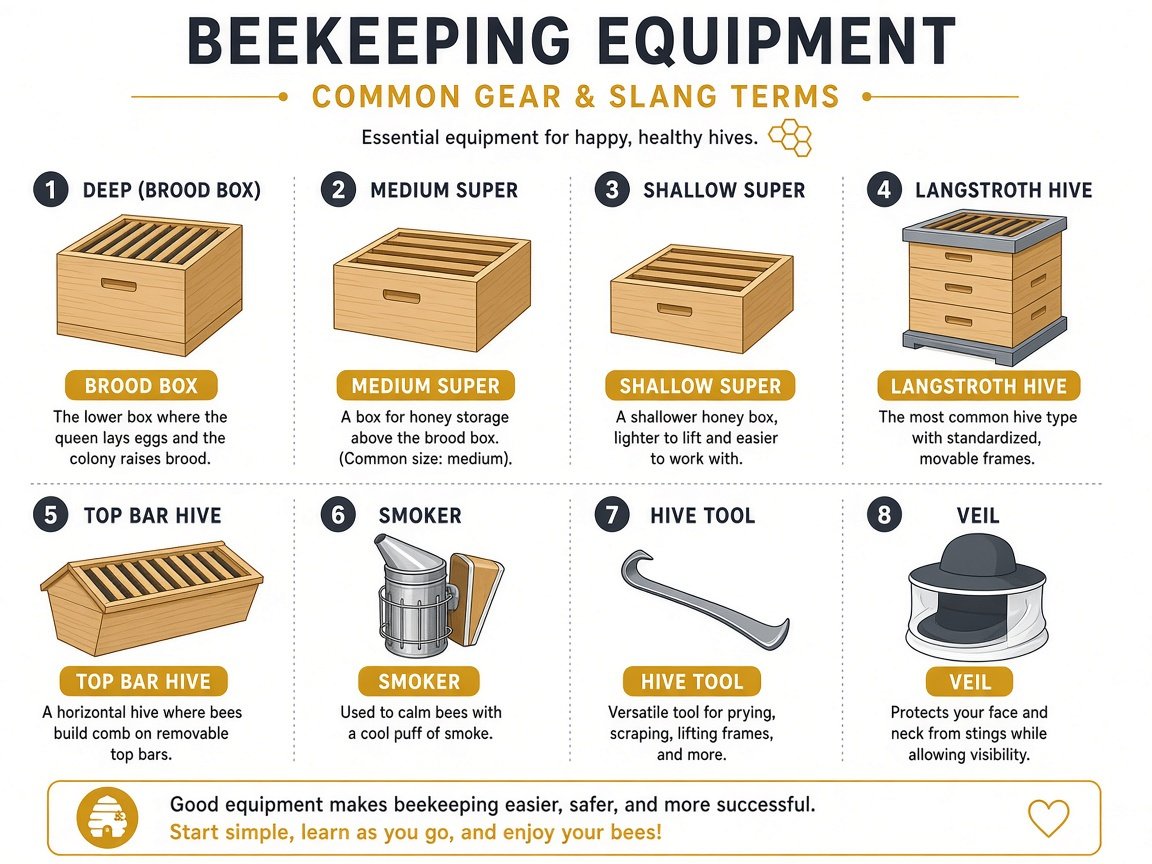
Beekeeping equipment has accumulated its own layer of shorthand over the years. The table below covers the most common gear-related slang terms you will encounter when visiting a club, watching a demonstration, or reading a forum thread:
| Slang Term | Formal Name | What It Means |
|---|---|---|
| Deep | Brood box / deep super | The largest hive box, used for raising brood |
| Medium | Medium super | A mid-sized box used for honey storage or brood |
| Shallow | Shallow super | A smaller box, primarily for honey collection |
| Langstroth | Langstroth hive | The most common modern hive design worldwide |
| Top bar | Top bar hive | A horizontal hive without full frames |
| Warré | Warré hive | A vertical hive designed for minimal intervention |
| Smoker | Bee smoker | The bellows device used to calm bees with smoke |
| Hive tool | Hive tool | The multipurpose prying and scraping implement |
| Veil | Bee veil / hood | The protective face covering worn during inspections |
The smoker deserves special mention. It is one of the most discussed pieces of beekeeping kit, and beekeepers have developed a whole sub-vocabulary around its use. The phrase “smoking them down” means using smoke to calm and settle an agitated colony before an inspection. If you want to understand what smoking slang really means in beekeeping practice, that article puts the terminology in context clearly.
What Does Colony Behaviour Slang Mean?
Some of the most useful beekeeping slang describes what a colony is actually doing. These behavioural terms are essential for diagnosing hive health and planning your management response. Learning them early helps you understand advice from more experienced keepers almost immediately.
- Bearding — Bees clustering densely on the outside of the hive entrance, forming a shape that resembles a hanging beard. This usually happens in hot, humid weather when the internal temperature rises. It is normal and rarely a cause for concern.
- Festooning — Bees linking their legs together to form hanging chains, usually during comb construction. It is a natural and visually striking behaviour that signals active building.
- Going queenless — A hive that has lost its queen. Without a queen, the colony cannot produce new worker bees and will eventually decline and die without beekeeper intervention.
- Queenright — The opposite of queenless: a hive with a healthy, actively laying queen present. “She’s queenright” is one of the most reassuring things you can say after an inspection.
- Hot hive — A colony that is unusually defensive and prone to stinging. “Hot” describes aggressive temperament, not temperature. Hot hives can develop due to genetics, stress, or queenlessness.
- Laying workers — Workers that begin laying unfertilised eggs when a hive stays queenless too long. These eggs produce only drones, compounding the colony’s problems.
- Walk-away split — A technique for dividing a colony where you let the queenless half raise its own queen from existing brood, with minimal follow-up needed from the beekeeper.
- Winter cluster — The tight ball of bees that forms in autumn and winter to maintain warmth. The cluster moves slowly through the hive, consuming honey stores as it goes.
What Are the Funniest Beekeeping Slang Terms?
Beekeeping humour tends to be dry, observational, and affectionate. The community pokes fun at itself freely, and several informal terms have become beloved in-jokes among keepers worldwide. These are the ones most likely to get a knowing laugh at a club meeting:
- Bee beard — When a beekeeper deliberately allows bees to cluster across their face and neck as a demonstration or spectacle. Not everyone’s first choice for Saturday entertainment.
- Bee math — The community in-joke about how beekeepers tend to undercount their hives. If you have two hives, you are probably about to have four. If you have four, you are heading for eight.
- Hive mind — Used affectionately to describe how experienced keepers seem to intuitively understand colony behaviour, as if sharing the bees’ own instincts.
- Bee vortex — The swirling cloud of bees that forms around a keeper when a colony is agitated. Usually experienced while trying to walk calmly away from an unhappy hive.
- Honey face — The sticky residue left on gloves, veils, and faces after an inspection. It travels everywhere and finds surfaces you forgot you touched.
The beekeeping world is full of these small jokes and in-references. The collection of funny beekeeping slang gathers many of the best examples from the community in one place — a great read for when you want to feel immediately at home in the culture.
What Does “Beekeeper” Mean in the Urban Dictionary?
The Urban Dictionary — the crowd-sourced online reference for informal and slang language — has its own take on beekeeping vocabulary. Some entries are playful extensions of real beekeeping terms applied to human social situations. Others invent metaphorical uses of “beekeeper” to describe personality types or social roles that have little to do with actual bees.
For example, “beekeeper” appears informally in some social contexts to describe someone who manages a large, busy social group — keeping the “bees” organised, productive, and from stinging each other. It is a metaphor that extends naturally from the core definition. Some Urban Dictionary entries are genuinely insightful; others are purely comedic and best not taken at face value.
The Urban Dictionary beekeeping slang decoded article separates the genuinely useful informal definitions from the absurd ones and puts each term into proper context — a worthwhile read if you are curious about how the broader internet interprets beekeeping language and culture.
How Can a Beginner Learn Beekeeping Slang?
Learning beekeeping slang is a natural part of learning to keep bees. The vocabulary will come to you over your first season if you approach it in the right way. Here is a step-by-step process that works well for most newcomers:
- Start with the fundamentals of how a hive works. Before slang makes sense, you need to understand what a queen, worker, and drone actually do. The beekeeping basics guide gives you that foundation quickly and clearly.
- Join a local beekeeping association. Most regions have clubs that meet regularly. Listening to experienced keepers discuss their hives is the fastest natural route to absorbing vocabulary in context.
- Keep a glossary nearby during your first year. Reading definitions once rarely cements them. You need to encounter terms multiple times in real situations before they stick.
- Ask questions without hesitation. Beekeeping communities are almost universally welcoming. Asking what a term means will almost always earn you a generous and detailed answer.
- Read inspection notes and hive journals shared online. Many experienced beekeepers share these publicly. Reading them regularly exposes you to slang used naturally in context, which is the fastest way to learn.
- Accept regional variation without stress. Beekeeping vocabulary differs slightly by country and region. Context usually makes the meaning clear, and no one expects newcomers to be fluent from day one.
By the end of your first full season, you will be using terms like “flow,” “split,” and “queenright” without thinking twice. The language becomes second nature surprisingly quickly once you are regularly working with bees and talking with other keepers.
What Are Future Trends in Beekeeping Lingo?
Language in specialist communities shifts gradually as technology, culture, and practice evolve. In beekeeping, several trends are shaping how the vocabulary grows over the coming years — and they are worth watching if you want to stay fluent in the community’s evolving dialect.
Tech-influenced terminology is entering the lexicon steadily. As more beekeepers adopt hive monitoring sensors, remote cameras, and digital logging tools, tech vocabulary is blending into everyday keeper conversation. Terms like “monitoring alert” and “sensor data” are becoming as familiar to tech-forward beekeepers as “smoker” and “hive tool” are to everyone else.
Urban beekeeping slang is also growing as a distinct sub-dialect. City-based beekeeping is expanding across Europe, North America, and beyond. Urban keepers are coining their own micro-vocabulary around rooftop hives, urban forage maps, and city-specific challenges that traditional rural beekeeping never needed language for.
Social media abbreviations have accelerated the spread of shorthand beyond anything previous generations of beekeepers experienced. Terms that once took years to circulate across a region now spread globally within months through forums, Facebook groups, and YouTube channels dedicated to beekeeping at every level.
The core vocabulary — swarm, flow, nuc, split, super — will remain stable because it describes fundamental aspects of bee biology that do not change. But the edges of the language will keep growing as the community and the practice evolve together.
Frequently Asked Questions About Beekeeper Definition Slang
What is the most common slang name for a beekeeper?
The most widely used formal slang term is apiarist. In casual conversation, bee farmer and bee wrangler are popular alternatives. The preferred term varies by region: “apiarist” is fairly common in the United Kingdom and Australia, while “bee farmer” tends to feel more natural in informal North American speech. All three are widely understood within the beekeeping community everywhere.
What does “nuc” mean in beekeeping slang?
“Nuc” is short for nucleus colony — a small, established colony typically housed in a five-frame box. Beekeepers buy or create nucs to start new hives or rebuild weak ones. The word is pronounced “nuke” and is one of the most frequently used pieces of beekeeping shorthand in both hobbyist and commercial circles.
What does “going queenless” mean?
A hive that is “queenless” has lost its queen bee. Without a queen, the colony cannot produce new worker bees and will eventually decline and die. Beekeepers use the phrase “going queenless” as informal shorthand for this hive emergency. It is one of the situations that prompts the fastest management response from an experienced keeper.
Is “bee wrangler” a real job title?
Not officially, but it is used informally. Some pest control workers who relocate bee colonies describe themselves as bee wranglers, as do some professional swarm catchers. It is also used as a cheerful self-description by hobby beekeepers who like the vivid image it creates — someone who actively manages bees with practical hands-on skill.
What does “hot hive” mean?
A “hot hive” is a colony that is unusually defensive and prone to stinging. The term “hot” describes aggressive temperament, not temperature. Hot hives can develop due to genetics, stress, disease pressure, or a prolonged queenless period. Experienced beekeepers often re-queen a hot hive to improve the colony’s overall temperament over the following season.
What is “bearding” in beekeeping slang?
Bearding is when bees cluster on the outside surface of the hive entrance in large numbers, creating a shape that resembles a hanging beard. It most commonly happens in hot and humid weather when the internal temperature of the hive rises. While it looks dramatic to newcomers, bearding is usually normal behaviour and not a sign of trouble.
Why do beekeepers say a hive is “queenright”?
“Queenright” means the hive has a healthy, actively laying queen. It is the opposite of queenless. Beekeepers use this term as quick shorthand during inspections: “She’s queenright” means the most fundamental requirement of colony health is confirmed. It is typically one of the first things a beekeeper checks during any hive visit.
Conclusion: Start Speaking the Language of the Hive
Understanding beekeeper definition slang opens a door into one of the world’s oldest and most rewarding communities. The formal terms — apiarist, apiculturist — give you a professional vocabulary for the right occasions. The everyday slang — nuc, flow, split, hot hive, queenright — gives you the working language of the hive yard, where the real beekeeping happens.
The vocabulary is not difficult to learn. It is built from practical observation of bees and hives, and it makes intuitive sense once you have spent a little time working with colonies. The community is generous with explanations, and nobody expects fluency on day one. Give yourself a full season, stay curious, and the language will come naturally.
Your next steps:
- Bookmark the glossary in this guide and revisit it before each hive visit during your first season.
- Connect with a local beekeeping club to hear the vocabulary used naturally in conversation by experienced keepers.
- Keep a hive journal and practise writing up your inspections using beekeeping slang — it cements the vocabulary faster than passive reading.
- When you encounter an unfamiliar term, look it up immediately rather than letting it slide. That single habit will build your vocabulary faster than anything else.
- Aim to use at least ten of the slang terms in this guide confidently and correctly by the end of your first full season in the hive yard.
The beekeeping community is welcoming and generous with knowledge. Learn the language, and you will find that the door to that community opens much more easily than you might expect.