We want to compare beekeeping methods so you can pick what fits. We’ll cover old-school log hives to modern movable frames, organic vs conventional choices, and even solar-heated designs. We think there’s no single best way; it’s like picking shoes—depends on the walk. Maybe some approaches sound risky, and maybe they are, but we’ll show trade-offs and why you might…
Some of the links in this article may be affiliate links. If you make a purchase through these links, we may earn a small commission at no extra cost to you. Thank you.
Traditional and Indigenous Beekeeping Practices

When we look at traditional and indigenous beekeeping, what stands out is how practical and improvised it often is. We use fixed sites where bees nest in logs or rock cavities, often with a large entrance; sometimes folks make simple log hives or pots with two holes. Harvesting is hands-on and rough — smoke rituals or even small fires at night are common, and people cut away comb or let decay do the work. They’re low-cost — I mean, low capital input, and accessible. We think it’s useful, but it’s not without problems: honey contamination and weaker colonies happen from uncontrolled access. Well, I’m not entirely sure, but we’re learning from them, honestly, and adapting, too. They remind us of resilience and community knowledge.
Modern Movable-Frame Beekeeping Techniques
A movable-frame hive feels like giving bees a modular apartment instead of a cave. We use detachable frames in a brood chamber and stack supers above, so we can expand brood or honey stores without chaos. Frame manipulation is central: we remove, rearrange, inspect, and harvest with care. Supers let honey rise while leaving the brood undisturbed. I think it’s efficient; in my experience you reuse comb after harvest which speeds things up and aids wax renewal — well, actually it promotes healthy comb cycles. The brood chamber, bottom board, lid and removable frames make transport and scaling easier. Maybe it’s not perfect, but we like the control it gives for queen rearing and targeted management, and it’s adaptable to growers’ goals and future plans.
Organic, Conventional, and Chemical-Free Management Systems
Having just described how movable-frame hives give us control over comb and brood, we should look at how different management philosophies shape what we actually do with that control. We compare Organic, Conventional and Chemical-Free systems, and the Penn State study gives us real data to chew on. Survival outcomes were much better under Organic and Conventional—over 180% higher than Chemical-Free—so that’s striking. Honey was up too: Organic +118%, Conventional +102% versus Chemical-Free, with no big difference between the two. Pathogen control was clearly stronger where treatments were used; parasites and viruses dropped. Immune gene expression was lower in treated systems, which is interesting. I think it’s a trade-off; we’re managing disease but maybe dampening natural defenses, you know? It feels like cautious compromise.
Hive Designs: Fixed, Transitional, and Thermosolar Hives
Hive-design choices shape not just how we keep bees but how the colony lives day to day — shelter-style decisions that steer inspection ease, honey yields, and long-term management. We often contrast fixed hives, changeover models like Kenyan or Greek baskets, and thermosolar units. Fixed setups mimic natural cavities with a large entrance and simpler airflow dynamics, and they’re traditional though not great for frame manipulation. Changeover hives are durable, cost-effective stepping-stones—easier inspections, you know, and a smoother move toward movable frames. Thermosolar hives use sunlight for pest control and steady temps; their solar efficiency helps guard colonies and they’ll produce about 75–80% of peak potential in good seasons. I think each has trade-offs; we’re choosing what fits our goals. That’s our approach, honestly.
Honey Harvesting Methods and Quality Assurance
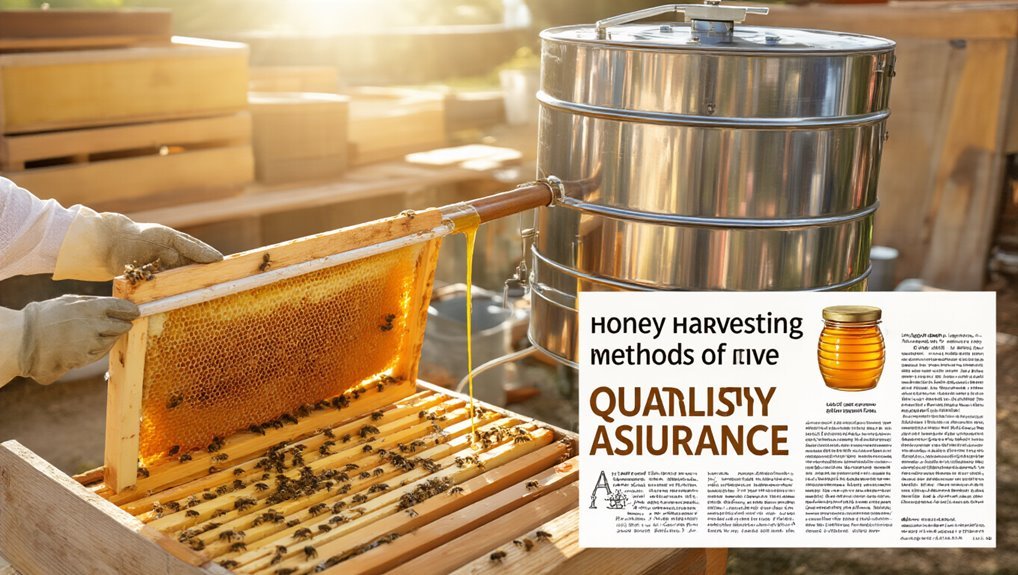
Harvesting honey is part art, part checklist — and honestly, we’ve learned to treat it like wringing out a towel: do it too hard or too quick and you’ll get mess, do it gentle and you’ll keep the good stuff. We use extractors or crush-and-strain depending on batch size. Extractors need smoking, uncapping, 10–12 minute spins and a halfway flip before straining; smash-and-strain uses two food-grade buckets and a potato masher overnight. We check moisture with refractometer calibration and a simple leakage test — no seep, no go. Bottling needs sanitation protocols, airtight jars and drying options. Quick list of priorities:
- Proper uncapping and spinning
- Moisture testing and waiting
- Clean bottles and tight seals
It’s simple, really; well, mostly, honestly though.
Economics, Regulations, and Marketing for Beginner Beekeepers
When we start talking money, rules, and getting your jars onto shelves, it can feel like trying to learn a new language — messy, full of weird abbreviations, and honestly a little thrilling. We recommend starting small: farmers markets, social media, and clear labels — Oklahoma needs common name, net weight, our name, ten-digit phone, production address, and that it was bottled in a facility not inspected by the Oklahoma Department of Health. Keep production under 500 gallons, keep hives in state, and sell raw honey only. Use breakeven analyses to test pricing strategies and starter budgets for 8-oz vs 1-lb jars. Don’t forget insurance options — Flip’s plan is about $300/yr. It’s a lot, but manageable. We’ll adjust as we learn, probably, together.
Frequently Asked Questions
What Are the Different Methods of Beekeeping?
Like a toolkit, we use traditional hives, Langstroth designs, Warre methods, top-bar and intermediate hives, conventional and organic management, and chemical-free or minimal-intervention approaches, so we’ll match methods to your goals and preferences easily today.
What Is the 7 10 Rule in Beekeeping?
There isn’t a defined ‘7 10 rule’ in our material; we can’t describe it. If you mean a Timing window or Replacement schedule, we’ll need your source or context so we can summarize and compare it.
What Is the 3 3 3 Rule for Bees?
Like a missing puzzle piece, we don’t have a defined 3 3 3 rule for bees; we can’t cite guidance on hive temperature or queen mating intervals, but we’ll help craft practical inspection guidelines now.
What Is the Easiest Type of Beehive to Use?
Traditional hives are the easiest to use; we value Langstroth simplicity for management and Topbar ease for low cost upkeep, and we’ll help you choose the system that fits your goals and beginner skills today.